
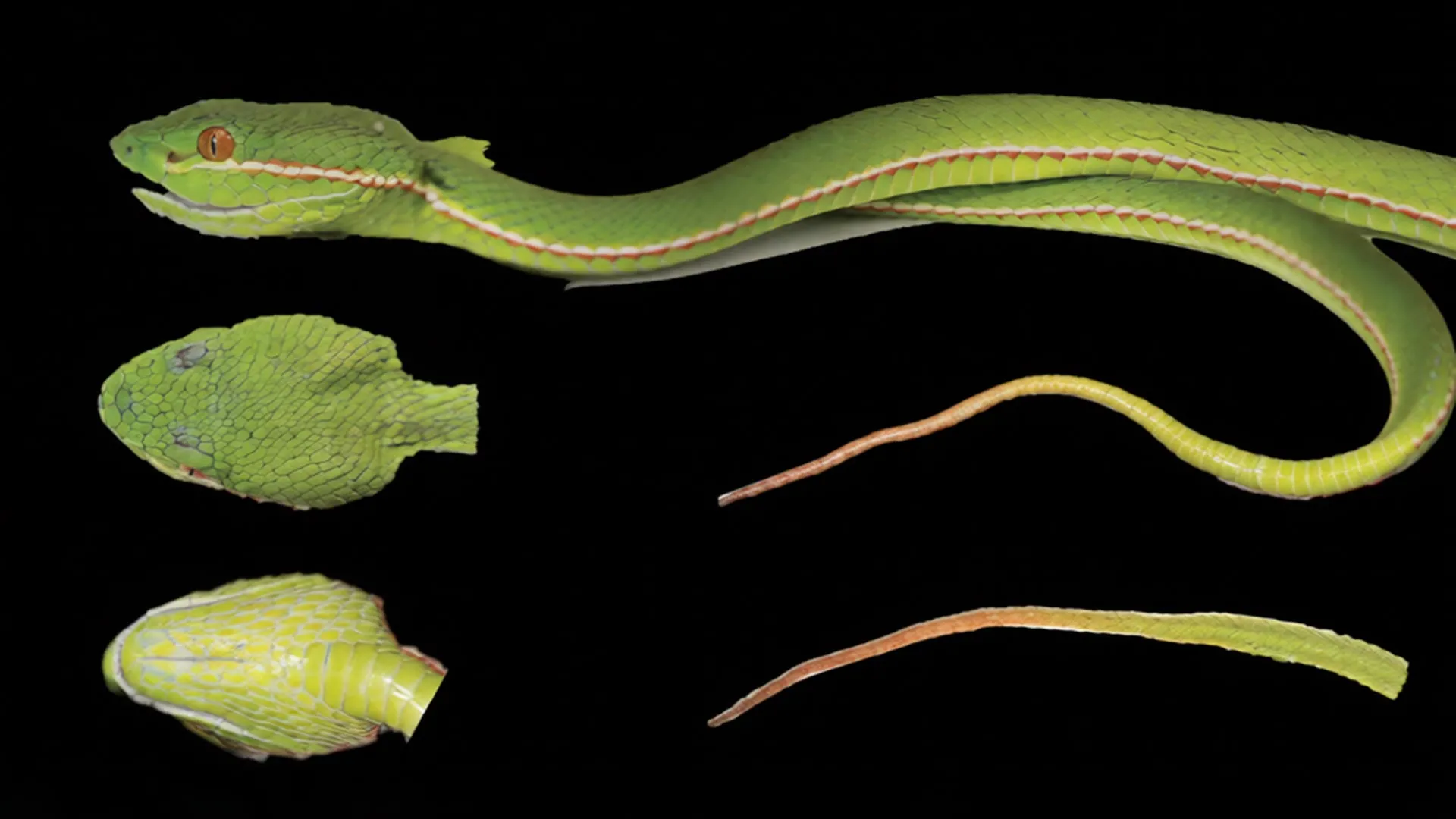
A vivid new pitviper, distinguished by its striking grass-green body and captivating amber-like eyes, has been unveiled from the mist-shrouded mountains of western Sichuan, China. This reclusive serpent, capable of blending seamlessly into its verdant habitat, had evaded scientific detection for years within one of the planet’s most celebrated biodiversity hotspots. The discovery, made by researchers from the Chengdu Institute of Biology and the Giant Panda National Park, underscores the continued unveiling of nature’s secrets even in well-explored regions.
Unveiling a Hidden Gem: The Genesis of Discovery
The discovery of Trimeresurus lii, now formally named the Huaxi Green Pitviper, was not a singular, dramatic event but rather the culmination of ongoing ecological research. Scientists were conducting wildlife surveys in the ecologically rich West China Rain Zone, an area renowned for its exceptional biodiversity and endemic species. During these expeditions, the team, led by herpetologist Bo Cai, encountered specimens that, at first glance, appeared to be a familiar resident of the region. However, upon closer examination, the researchers recognized subtle yet significant divergences from known species.
"What initially appeared to be a common bamboo pitviper, Trimeresurus stejnegeri, presented characteristics that didn’t quite align with established descriptions," stated a representative from the research team. "This prompted a deeper investigation, involving meticulous morphological analysis and advanced genetic sequencing." The diligent work over several months, spanning field observation, specimen collection, and laboratory analysis, ultimately confirmed their suspicions: they had encountered a species entirely new to science.
A Name Rooted in Philosophy and Conservation
The nomenclature bestowed upon this newly identified serpent carries a profound cultural and philosophical significance. The scientific name, Trimeresurus lii, pays homage to Li Er, the revered ancient Chinese philosopher more widely known as Laozi. Laozi, the principal figure of Taoism, articulated a philosophy deeply centered on the harmonious coexistence of humanity and the natural world.
"The selection of ‘lii’ as the specific epithet was a deliberate choice," explained the research team. "Laozi’s teachings, particularly his emphasis on living in accordance with the Tao – the natural order of the universe – resonate powerfully with the core mission of the Giant Panda National Park. This park is a testament to the vital importance of preserving ecosystems and fostering a balance between human endeavors and wildlife conservation. The Huaxi Green Pitviper, thriving within this protected landscape, embodies that very principle of harmonious existence." This thoughtful naming convention serves not only to honor a significant cultural figure but also to imbue the species with a symbolic connection to its conservation context.
Morphological and Genetic Confirmation: Distinguishing the Huaxi Green Pitviper
The formal recognition of Trimeresurus lii as a distinct species involved rigorous scientific scrutiny. The Huaxi Green Pitviper now stands as the 58th recognized member of the Trimeresurus genus, a diverse group of pit vipers found across Asia. Furthermore, it represents only the second species from its specific subgenus to be documented within Sichuan Province, highlighting its unique evolutionary trajectory.
For a considerable period, scientists had inadvertently classified these snakes as bamboo pitvipers due to their remarkably similar vibrant green coloration, an effective camouflage in their leafy environment. This visual mimicry had, for decades, obscured the genetic and morphological distinctions that set them apart.
The breakthrough came through advanced DNA analysis. Genetic sequencing revealed that the Huaxi Green Pitviper occupies its own distinct evolutionary branch, separate from its presumed relatives. This genetic divergence provided irrefutable evidence of its unique species status. Complementing the genetic findings, detailed examination of physical traits revealed consistent morphological differences. Notably, the smooth texture of its head scales distinguishes it from other closely related pitviper species, providing a tangible, observable characteristic that aids in identification.
A Symphony of Color and Form: The Unique Appearance of Trimeresurus lii
The discovery, officially documented and published in the peer-reviewed, open-access journal Zoosystematics and Evolution, sheds light on a serpent exquisitely adapted to its arboreal niche. The Huaxi Green Pitviper exhibits a captivating aesthetic, with both male and female individuals boasting a brilliant grass-green dorsal coloration. However, subtle yet distinct differences in their appearance contribute to sexual dimorphism.
Males are characterized by a striking red and white lateral stripe that runs along the length of their bodies, a bold visual accent against their green backdrop. Their eyes are a vivid amber hue, adding to their mesmerizing appearance. Females, while sharing the green base, present a more subdued elegance. They typically display a simpler yellow stripe along their sides and possess eyes that range from yellow to orange-yellow. These color variations likely play roles in species recognition, courtship, or even thermoregulation within their specific microhabitats.
The smooth head scales, a key diagnostic feature, contribute to the snake’s sleek profile, further differentiating it from species with more prominently keeled scales. This combination of vibrant coloration and subtle morphological variations makes the Huaxi Green Pitviper a visually striking addition to the known herpetofauna of the region.
The Double-Edged Sword: Venomous Nature in a Shared Landscape
As a member of the Trimeresurus genus, the Huaxi Green Pitviper is venomous. Like many pit vipers, its venom is primarily hemotoxic, meaning it affects blood and tissues, and can cause significant envenoming if a bite occurs. While the precise potency and clinical effects of its venom are still under investigation, its venomous nature necessitates caution.
The discovery is particularly relevant given the snake’s habitat. The mountainous regions where the Huaxi Green Pitviper resides are increasingly areas of human activity, including eco-tourism, agricultural endeavors, and local community settlements. This overlap in habitat means that encounters between humans and the snake are possible, presenting a potential risk of snakebite envenoming.
"Understanding the venom composition and the snake’s behavior is crucial for developing appropriate first-aid protocols and public awareness campaigns," stated a medical professional specializing in venomous bites, who preferred to remain anonymous. "While this discovery is scientifically exciting, it also serves as a reminder of the importance of respecting wildlife and taking precautions when venturing into their natural environments." The research team emphasized that this species, like many venomous snakes, is likely to be shy and avoid human contact unless provoked or threatened.
A Biodiversity Hotspot Continues to Astonish
The discovery of the Huaxi Green Pitviper in the West China Rain Zone is a potent reminder of the extraordinary biodiversity harbored within this region. These mountains, including iconic locales such as Mt. Emei and Xiling Snow Mountain, are globally recognized biodiversity hotspots. They are characterized by their humid forests, varied topography, and a rich tapestry of endemic flora and fauna.
The Huaxi Green Pitviper can reach impressive lengths of nearly 80 centimeters (approximately 32 inches). Its presence further highlights the intricate ecological webs that exist within these humid forests. Despite decades of exploration and scientific interest, the sheer scale and complexity of these ecosystems mean that many species remain undiscovered or poorly understood.
"This discovery is not an isolated incident; it is symptomatic of the vast amount of biological knowledge that still awaits revelation," remarked Dr. Anya Sharma, a conservation biologist not involved in the study. "Biodiversity hotspots are critical for global ecological health, and they continue to surprise us with their hidden treasures. Such discoveries underscore the urgent need for continued investment in biodiversity research and conservation efforts."
The researchers themselves echoed this sentiment. "Our findings emphatically underscore the importance of sustained field surveys and rigorous taxonomic research, particularly in these globally significant biodiversity hotspots," they stated. "Even in areas that have been subject to scientific inquiry for years, there are still profound discoveries to be made. This highlights the imperative to protect these invaluable ecosystems before their unique inhabitants are lost forever."
Implications for Conservation and Future Research
The identification of Trimeresurus lii carries several significant implications for conservation strategies and future scientific inquiry.
Firstly, it necessitates a re-evaluation of conservation priorities within the West China Rain Zone. The existence of a previously unknown pitviper species suggests that other endemic and potentially vulnerable species may also be awaiting discovery. This calls for enhanced habitat protection measures, stricter enforcement of anti-poaching laws, and a more comprehensive understanding of the ecological roles played by all species within the ecosystem.
Secondly, the discovery will likely spur further herpetological research in the region. Scientists will be keen to understand the population size, distribution, reproductive biology, and specific ecological niche of the Huaxi Green Pitviper. Further studies on its venom composition and potential medicinal applications could also emerge.
Thirdly, the case of the Huaxi Green Pitviper serves as a compelling example of how advancements in genetic technology can revolutionize taxonomy. The ability to analyze DNA has provided definitive proof of species distinction, overcoming the limitations of purely morphological identification, especially in cases of cryptic species that exhibit close physical resemblance.
The researchers’ call for continued field surveys is particularly pertinent. It suggests that the current understanding of biodiversity in many regions is likely incomplete. Each new discovery adds another piece to the intricate puzzle of life on Earth, reinforcing the need for a precautionary approach to environmental management and conservation. The Huaxi Green Pitviper, a jewel of Sichuan’s natural heritage, is a testament to the enduring mysteries and wonders that our planet still holds.