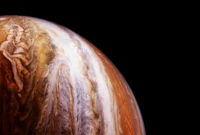

The vast, enigmatic plains that dominate the surface of Saturn’s largest moon, Titan, may owe their remarkably flat and smooth appearance to a thick, fluffy coating of organic material. Scientists hypothesize that this pervasive layer, potentially reaching up to a meter in depth, is the result of a unique form of atmospheric precipitation – an "organic snow" that has gradually accumulated from Titan’s dense, nitrogen-rich atmosphere over eons. This groundbreaking insight, derived from a re-examination of radar data from the Cassini spacecraft, offers a compelling explanation for one of Titan’s most striking geological features and deepens our understanding of this alien world.
For decades, Titan has captivated planetary scientists with its Earth-like characteristics, including a dense atmosphere, liquid on its surface (albeit methane and ethane rather than water), and a complex weather system. However, the uniformity of its extensive plains, which constitute approximately 65 percent of its surface, has long puzzled researchers. Unlike the rugged terrains found on many other celestial bodies, these plains exhibit an almost unnerving flatness, suggesting a process that smooths out irregularities and builds up a consistent surface layer. The new research, led by Alexander Hayes of Cornell University, proposes that this smoothing agent is a slow, continuous deposition of organic particles.
Unveiling Titan’s Surface with Cassini Radar
Studying Titan’s surface from Earth is a formidable challenge due to its thick, opaque atmosphere, which largely conceals the moon’s features. The Cassini-Huygens mission, a collaborative effort between NASA, the European Space Agency (ESA), and the Italian Space Agency (ASI), provided an unprecedented opportunity to probe this veiled world. Cassini, which orbited Saturn from 2004 to 2017, was equipped with a sophisticated radar instrument capable of penetrating Titan’s atmospheric haze. This instrument mapped significant portions of the moon’s surface, revealing a diverse landscape of lakes, rivers, mountains, and dunes.
Hayes and his team meticulously analyzed the radar reflectivity data collected by Cassini. The way radar waves interact with a surface provides crucial information about its composition and texture. Standard models used to interpret radar signals from rocky bodies like the Moon, Earth, and Venus proved inadequate when applied to Titan’s plains. "The canonical models that we use to try to understand Titan’s surface, which were developed for the moon and are used for the moon, Earth, Venus – they don’t work directly on Titan," explained Hayes in a statement. "Titan is a different beast in terms of the radar-scattering properties of the surface."
A Two-Layered Surface: The "Organic Snow" Hypothesis
The analysis revealed that the radar signals from Titan’s plains were best explained by a two-layer model. This model suggests that a relatively soft, low-density material forms a pervasive blanket atop a more solid, underlying terrain. This superficial layer, estimated to be anywhere from a few centimeters to as much as a meter thick, is believed to be composed of complex organic molecules.
These organic molecules are thought to originate from Titan’s upper atmosphere, where solar ultraviolet radiation and Saturn’s magnetospheric electrons interact with methane and nitrogen. This photochemical process creates a cascade of complex hydrocarbons and nitriles, which then condense and form the thick, ubiquitous haze that shrouds the moon. According to the prevailing hypothesis, these organic compounds gradually "snow" down from the atmosphere, accumulating on the surface over geological timescales.
"The radar data is a better fit to a two-layer model, with a blanket of soft, low-density material covering a harder terrain," the article states. This "blanket layer" is likely comprised of these atmospheric organic compounds. Over time, this deposited material would likely become compacted and solidified, forming the smooth, uniform plains observed. This process is akin to how snow accumulates on Earth, but with a fundamentally different chemical composition and under drastically different environmental conditions.
Titan’s Unique Weathering and Erosion
While the "organic snow" hypothesis offers a compelling explanation for the material composing the plains, the question of how these plains maintain their flatness in the face of Titan’s dynamic weather remains. Titan experiences a hydrological cycle analogous to Earth’s, but with liquid methane and ethane instead of water. This includes precipitation in the form of methane rain, erosion by liquid flows, and wind-driven processes.
"Titan’s surface also experiences rain, wind and erosion, so it is important to understand how the blanket layer has built up slowly over time, shaped by these processes," the researchers noted. The slow, continuous deposition of organic material could act as a buffering agent, constantly replenishing the surface and counteracting the erosional forces that might otherwise create more varied topography. The softness and low density of the organic layer would also allow it to absorb impacts and fill in smaller depressions, contributing to the overall smoothness.

Implications for Future Exploration
Understanding the composition and formation of Titan’s plains is not merely an academic pursuit; it has significant implications for future space exploration. NASA’s Dragonfly mission, scheduled to launch in 2028 and arrive at Titan in 2034, is designed to explore this intriguing moon in unprecedented detail. The mission will deploy a rotorcraft lander to investigate diverse locations, including the plains, and directly sample surface materials.
"NASA’s Dragonfly mission, which is expected to launch in 2028 and arrive on Titan in 2034, should be able to measure these layers and help us figure out exactly how they formed," the article highlights. The ability of Dragonfly to measure the thickness and properties of these surface layers will be crucial in validating or refining the "organic snow" hypothesis.
Furthermore, this knowledge is essential for the design and operation of future spacecraft missions. A thorough understanding of the surface properties, including its bearing strength and composition, will inform the landing site selection and the engineering required for successful touchdowns. The peculiar nature of Titan’s surface, potentially being a meter-deep layer of fluffy organic material, presents unique challenges and considerations for spacecraft engineers.
Broader Context: Titan’s Place in the Solar System
Titan stands as a unique world within our solar system, often described as an early Earth analogue due to its atmospheric density, weather patterns, and the presence of liquids on its surface. Its frigid temperatures, averaging around -179 degrees Celsius (-290 degrees Fahrenheit), necessitate the use of different chemical compounds for its hydrological cycle. The methane rain and ethane lakes, though alien in composition, mirror Earth’s water cycle, providing a fascinating case study in comparative planetology.
The complex organic chemistry occurring in Titan’s atmosphere is a key area of interest for astrobiologists. The building blocks for life as we know it are present, and the presence of liquid, albeit hydrocarbon, raises questions about the potential for prebiotic chemistry or even extant life in exotic forms. The "organic snow" contributes to this complex chemical environment, acting as a repository of atmospheric chemistry that can interact with the surface and potentially subsurface reservoirs.
The Cassini mission, which concluded in September 2017 with a planned plunge into Saturn’s atmosphere to avoid contaminating Titan or Enceladus, provided a wealth of data that continues to be analyzed. The mission’s extended duration allowed for multiple close flybys of Titan, enabling detailed radar mapping and atmospheric measurements. This latest research underscores the enduring value of this mission’s data, even years after its operational phase.
A Glimpse into a Hazy Future
The implications of this research extend beyond understanding Titan’s surface geology. It provides a deeper insight into the atmospheric-surface interactions on a moon with a dense organic atmosphere. This understanding can be extrapolated to other bodies with similar atmospheric compositions or processes, though Titan remains an exceptional case.
The discovery also prompts further questions: How long does it take for a meter of organic material to accumulate? What is the rate of deposition, and how does it vary across different regions of Titan? Are there distinct layers within this blanket, reflecting different epochs of atmospheric chemistry or deposition rates? The answers to these questions will likely emerge from continued analysis of Cassini data and, more significantly, from the direct observations and measurements that the Dragonfly mission will provide.
As humanity continues to explore the solar system, Titan remains a prime target for scientific inquiry. Its bizarre and beautiful landscapes, shaped by processes both familiar and alien, offer a unique window into the diverse ways planetary bodies can evolve. The enigma of its flat, smooth plains, now potentially explained by a gentle, persistent fall of organic snow, is a testament to the enduring power of scientific observation and the captivating mysteries that await us in the cosmos. The upcoming Dragonfly mission promises to unravel more of Titan’s secrets, bringing us closer to understanding the full story of this remarkable, hazy moon.