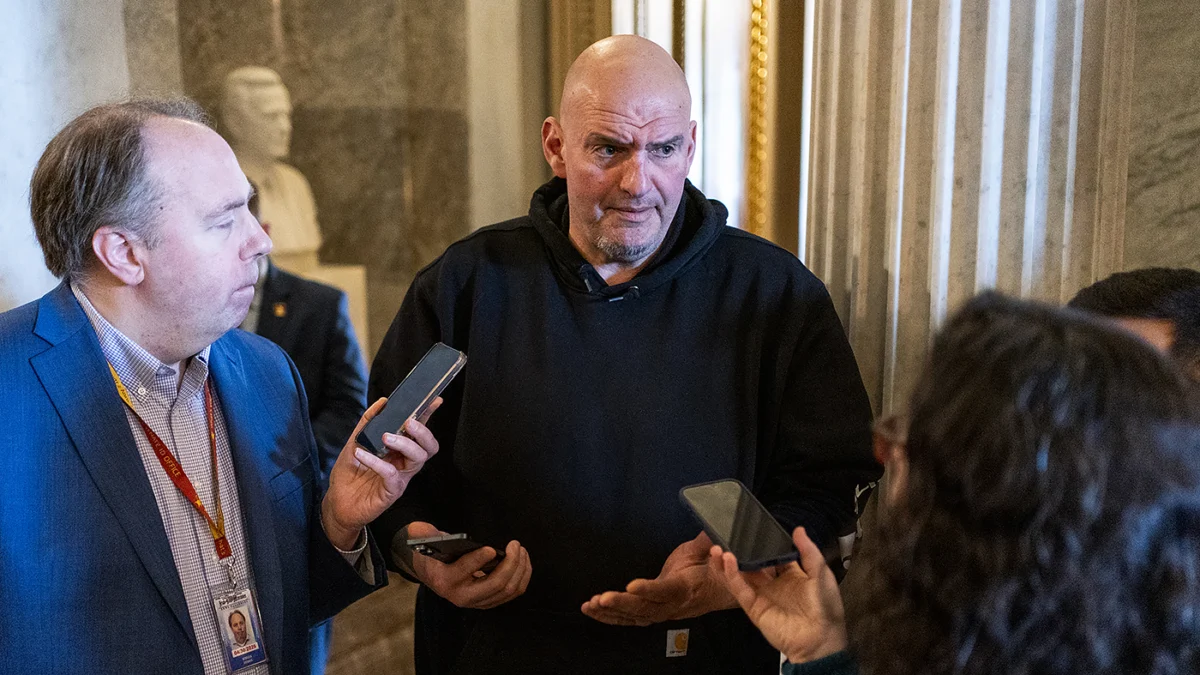
Democratic Senator John Fetterman of Pennsylvania reacted with palpable dismay on Tuesday evening when he was informed during an appearance on NewsNation’s “Cuomo” that a Democratic-backed redistricting initiative had successfully passed in Virginia. His immediate declaration, “We all lose at this point,” underscored a broader concern among some politicians and electoral reform advocates about the escalating trend of partisan gerrymandering across the United States. Fetterman elaborated, stating, “I mean, I think everyone loses for that,” when host Chris Cuomo revealed that Democrats were projected to secure approval for a congressional map in Virginia designed to aggressively favor their party.
The Senator’s reaction highlighted a complex ethical dilemma within American politics: the practice of drawing electoral district boundaries to give one political party an unfair advantage over another. While acknowledging the strategic impetus behind such moves, Fetterman articulated a moral objection, pointing out that the Democratic push in Virginia was a direct response to a similar, aggressively partisan redistricting effort by Republicans in Texas. “I understand this was all that started after Texas decided to kind of do the same thing. I mean, I get the logic to do the things, but overall, we all lose at this point,” he explained, unequivocally asserting that “The wrong thing doesn’t make it the right thing.” He warned of the corrosive effect of this cycle: “And if we continue to just attack the other side, whether it’s a red state or whether it’s a blue state, our democracy is degraded.”
Understanding Gerrymandering: A Historical and Legal Overview
Gerrymandering, the practice of manipulating electoral district boundaries for partisan advantage, is a deeply entrenched feature of American political history. The term itself originated in 1812 when Massachusetts Governor Elbridge Gerry signed a bill that created a salamander-shaped district to benefit his party, prompting a cartoonist to coin the portmanteau "Gerry-mander." Since then, both major parties have engaged in the practice whenever they have held sufficient control over state legislatures and governorships.
The process typically occurs every ten years following the decennial U.S. Census, which determines population shifts and dictates the number of congressional seats each state receives. State legislatures are then tasked with redrawing district lines to ensure equal population distribution. However, this constitutional mandate often becomes a political battleground, as parties strategically draw lines to pack opposing voters into a few districts, thus wasting their votes, or to crack them across multiple districts to dilute their influence.
Legally, gerrymandering has faced numerous challenges. The Supreme Court has intervened on several occasions, most notably establishing the "one person, one vote" principle in cases like Reynolds v. Sims (1964) to ensure population equality. Racial gerrymandering, designed to dilute the voting power of minority groups, has been deemed unconstitutional under the Voting Rights Act of 1965 and the Equal Protection Clause of the Fourteenth Amendment. However, partisan gerrymandering – drawing lines specifically for political party advantage – has proven much harder for courts to address. In the landmark 2019 case Rucho v. Common Cause, the Supreme Court ruled 5-4 that federal courts have no jurisdiction to hear cases involving partisan gerrymandering, effectively leaving the issue to state courts and legislative processes. This ruling significantly emboldened state parties to pursue aggressive redistricting strategies, as their maps would not face federal judicial review on partisan grounds.
The Virginia Context: From Independent Commission to Partisan Control
The redistricting saga in Virginia is particularly illustrative of the challenges facing electoral reform. For years, Virginia had been a battleground state with a history of politically drawn maps. Public dissatisfaction with this led to a significant movement for reform, culminating in 2020 with the passage of a constitutional amendment by Virginia voters. This amendment aimed to create a bipartisan independent redistricting commission, composed of eight citizens and eight legislators, to draw the state’s congressional and legislative districts. The goal was to remove partisan politics from the process and ensure fair maps.
However, despite overwhelming public support for the amendment (which passed with over 65% of the vote), the independent commission ultimately failed to agree on new maps following the 2020 Census data release. The bipartisan nature, intended to foster consensus, instead led to deadlock, with neither side willing to compromise sufficiently. This failure meant that the responsibility for drawing the maps reverted to the state legislature, where Democrats held a narrow majority in both chambers and the governorship at the time.
Given the Rucho v. Common Cause ruling and the intense national stakes of the 2022 midterm elections, Virginia Democrats seized the opportunity to draw maps favorable to their party. The initiative that passed narrowly, by a vote of 51 percent to 49 percent, was designed to rework the state’s congressional boundaries in a way that could significantly alter the political landscape. Prior to the new map, Virginia’s congressional delegation held a 6-seat-to-5-seat advantage for Democrats. The approved redistricting plan was projected to allow the Democratic party to potentially control 10 of the state’s 11 House seats, a dramatic shift that would solidify their power for the remainder of the decade, until after the 2030 census when another redistricting cycle would commence, theoretically under the independent commission if it could overcome its prior impasses.
The "Tit-for-Tat" Dynamic: Texas and the National Redistricting Battleground
Senator Fetterman’s explicit reference to Texas highlights a disturbing national pattern in the post-2020 Census redistricting cycle. Across the country, both Republican and Democratic state legislatures, emboldened by the Supreme Court’s stance on partisan gerrymandering, engaged in aggressive map-drawing to maximize their party’s electoral advantage.
In Texas, a rapidly growing state that gained two congressional seats after the 2020 Census, Republicans controlled both legislative chambers and the governorship. They used this power to draw new maps that were widely seen as among the most gerrymandered in the nation. These maps effectively solidified Republican control over a majority of the state’s 38 congressional districts, drawing lines to protect incumbents and dilute the voting power of growing minority populations and urban Democratic strongholds. House Democratic Leader Hakeem Jeffries (N.Y.) directly referenced this, stating, “Last July, Donald Trump demanded that Texas draw five new Republican seats in the middle of a decade, igniting a chain reaction of corrupt MAGA state legislators attempting to rig the midterm elections.” He presented the Virginia outcome as a necessary counter-measure: “While many expected Democrats to roll over and play dead, we did the opposite.”
This "tit-for-tat" approach has created a national redistricting battleground, where each party attempts to gain an advantage in states where they control the process, often at the expense of fair representation and competitive elections. Data from organizations like the Brennan Center for Justice and the Princeton Gerrymandering Project indicated that a significant percentage of congressional districts drawn after the 2020 Census were highly gerrymandered, with fewer truly competitive districts than in previous cycles. This trend suggests that the outcomes of many elections are increasingly predetermined by the drawing of lines rather than the preferences of voters.
Key Stakeholder Reactions and Justifications
The passage of the Virginia redistricting initiative, and the broader phenomenon of partisan map-drawing, elicited diverse reactions from across the political spectrum:
- Senator John Fetterman (D-PA): As detailed, Fetterman expressed profound disappointment, arguing that such partisan maneuvers ultimately degrade democracy and result in a net loss for the country, regardless of which party gains an advantage. His stance reflects a segment of the Democratic party and broader electorate that prioritizes electoral fairness over short-term partisan gains.
- House Democratic Leader Hakeem Jeffries (D-NY): Jeffries’ statement represented the more aggressive, pragmatic wing of the Democratic party. He framed the Virginia victory as a necessary defensive action against Republican gerrymandering, particularly citing the actions in Texas. For Jeffries and others, unilateral disarmament in the face of aggressive Republican tactics would simply concede electoral ground, making it harder to pass their legislative agenda.
- Virginia Democrats (inferred): While specific statements are not provided, the passage of the initiative suggests that Virginia Democrats justified their actions as a strategic necessity. They likely argued that if Republicans were to draw highly partisan maps in states they controlled, Democrats needed to do the same where they had the power to protect their electoral prospects and ensure their voices were heard in Congress. They might also point to the failure of the independent commission as necessitating legislative action.
- Virginia Republicans (inferred): Republicans in Virginia and nationally would likely condemn the Democratic-drawn map as a blatant power grab, hypocritical given Democratic rhetoric about fair maps, and an affront to the spirit of the constitutional amendment for an independent commission. They would likely criticize the map for disenfranchising Republican voters and creating non-competitive districts.
- Electoral Reform Advocates and Non-Partisan Watchdog Groups: Organizations dedicated to fair elections, such as Common Cause, the League of Women Voters, and the Brennan Center for Justice, would almost certainly lament the outcome in Virginia. They consistently advocate for independent commissions and non-partisan criteria in redistricting, viewing partisan gerrymandering as a fundamental threat to democratic principles, voter engagement, and accountability. They would likely argue that such maps lead to increased polarization, as politicians in safe districts primarily cater to their base rather than seeking common ground.
Implications for Democratic Governance and Voter Representation
The escalating trend of partisan gerrymandering, exemplified by the Virginia and Texas cases, carries profound implications for American democratic governance and voter representation:
- Reduced Electoral Competitiveness: Gerrymandered maps create "safe" districts where one party is virtually guaranteed to win, regardless of the quality of the candidate or the prevailing political winds. This reduces the number of truly competitive elections, diminishing the incentive for candidates to appeal to a broad base of voters and potentially leading to lower voter turnout.
- Increased Political Polarization: In safe districts, the primary threat to an incumbent often comes from a primary challenger within their own party, rather than a general election opponent. This pushes candidates further to the ideological extremes to appeal to their party’s most active voters, contributing to increased partisan polarization in Congress and state legislatures.
- Lack of Accountability: When incumbents are insulated from general election challenges, they become less accountable to the broader electorate. They can vote along strict party lines without fear of retribution at the ballot box, making compromise and bipartisan cooperation more difficult.
- Dilution of Minority Representation: While racial gerrymandering is illegal, partisan gerrymandering can indirectly dilute the voting power of minority groups if those groups tend to vote for a particular party. This can lead to a less representative legislative body.
- Erosion of Public Trust: When voters perceive that election outcomes are predetermined by mapmakers rather than their own votes, it erodes trust in the democratic process itself. This cynicism can lead to disengagement and further polarization.
- Unstable Political Landscape: While gerrymandering aims to create stability for the controlling party, extreme maps can sometimes backfire. Furthermore, the "tit-for-tat" approach creates an unstable political environment where the balance of power can swing wildly based on which party controls state capitals during the redistricting cycle.
The Road Ahead: Challenges to Gerrymandering and Future Prospects
Despite the current landscape, efforts to combat partisan gerrymandering continue. State-level legal challenges, based on state constitutions (which may have different provisions than the federal constitution), represent one avenue. Several states have seen successful challenges to partisan maps in state courts. Citizen-led ballot initiatives to establish independent redistricting commissions have also gained traction in some states, bypassing state legislatures entirely.
On the federal level, proposals like the For the People Act (H.R. 1) have sought to establish national standards for redistricting, including requirements for independent commissions and non-partisan criteria. However, such legislation faces significant hurdles in Congress, requiring bipartisan support that has been elusive.
The long-term prospect for mitigating gerrymandering remains uncertain. While technological advancements allow for increasingly precise and sophisticated gerrymandering, they also enable greater transparency and analysis of maps, empowering reform advocates. The debate over fair maps is not merely about electoral advantage; it is fundamentally about the health and integrity of American democracy, reflecting a core tension between political strategy and the principle of genuine voter representation. Senator Fetterman’s dismay reflects a growing concern that without significant reform, the cycle of partisan map-drawing will continue to degrade the very foundations of American self-governance.