
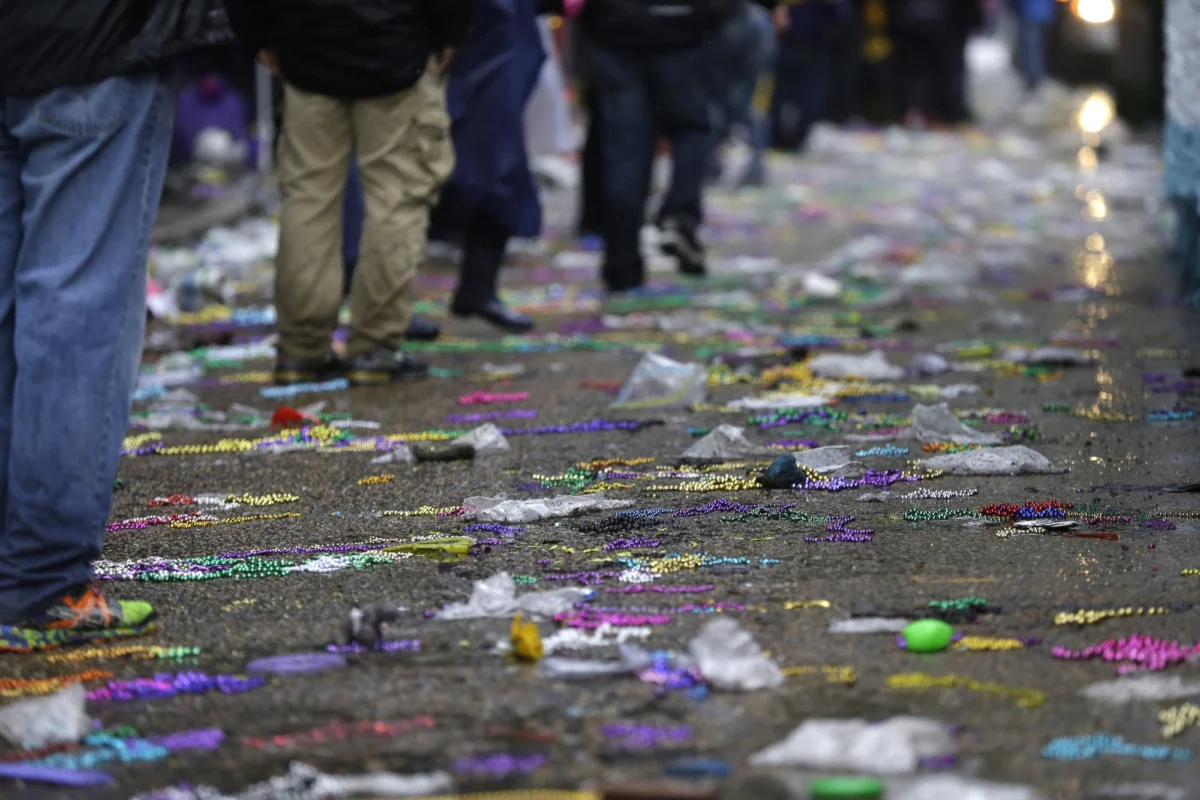
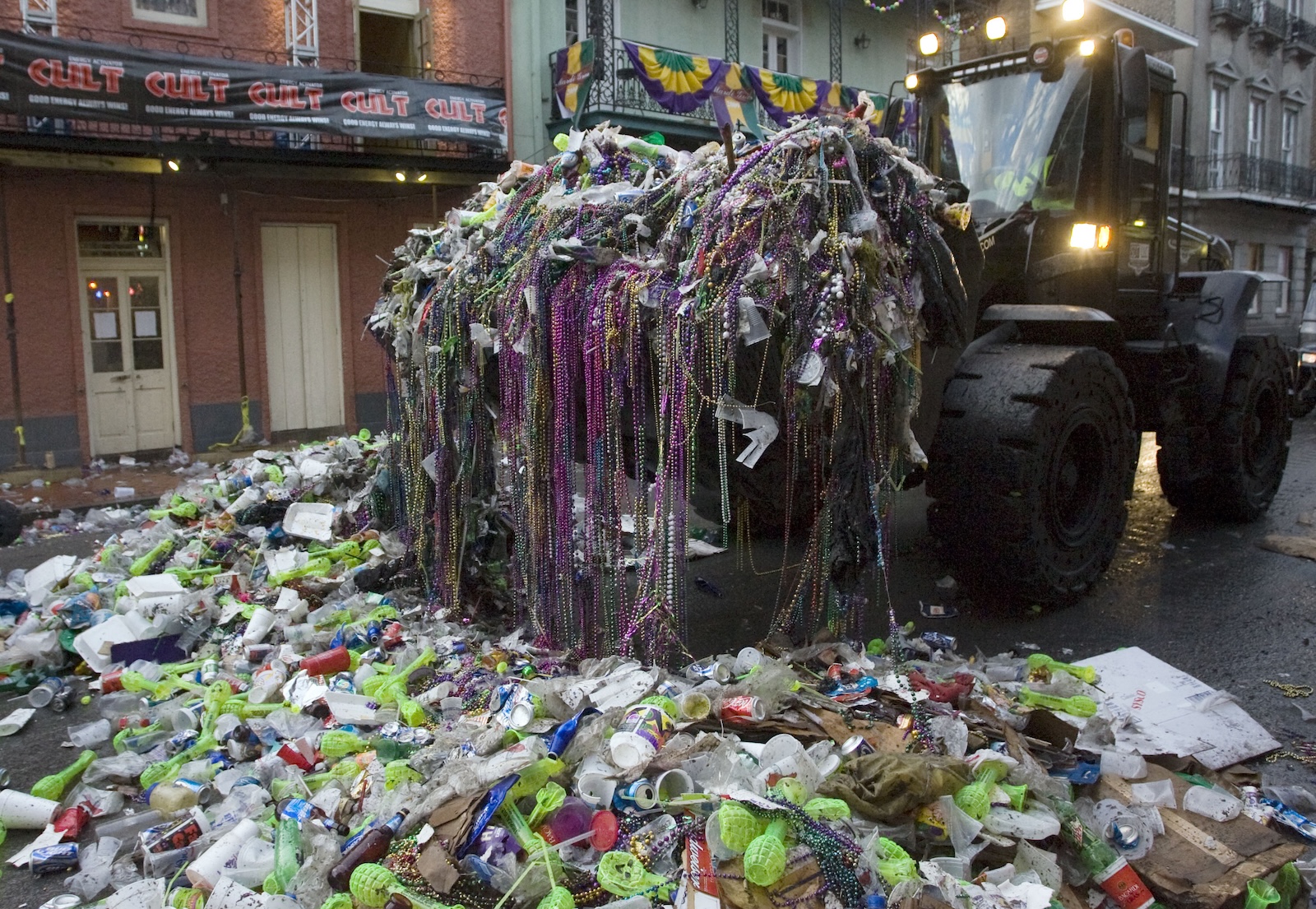
New Orleans is grappling with an unprecedented surge in Mardi Gras waste, with recent festivities generating more trash than ever before, despite efforts to promote sustainability and a shift towards higher-quality parade throws. In 2018, a stark revelation emerged when cleaning crews unearthed a staggering 46 tons of Mardi Gras beads from clogged storm drains, highlighting the significant environmental impact of the city’s iconic celebration. This discovery served as a wake-up call, prompting then-Public Works director Dani Galloway to declare, "Once you hear a number like that, there’s no going back. So we’ve got to do better." However, nearly a decade later, that sentiment seems to have been overshadowed by a growing mountain of refuse.
During the approximately five-week Carnival season this year, sanitation crews collected a record-breaking 1,363 tons of debris along parade routes. This figure, comprising beaded necklaces, beer cans, plastic cups, and other assorted refuse, represents a concerning 24 percent increase from the previous year and signifies the highest total on record. To contextualize this immense volume, it is equivalent to the weight of 741 cars, or in New Orleans terms, roughly the weight of the historic Steamboat Natchez or more than one million king cakes.
The Escalating Tide of Carnival Waste
The sheer magnitude of this year’s trash collection has drawn sharp criticism and concern from environmental advocates. Brett Davis, founder of Grounds Krewe, a nonprofit dedicated to fostering a more sustainable Mardi Gras through recycling and waste reduction, expressed dismay, stating, "To see the waste go up that much, it’s just absurd."
The tradition of "throws"—items tossed from parade floats by riders to enthusiastic crowds—has been a cornerstone of Mardi Gras for over a century. These throws, often inexpensive plastic trinkets and beads, have come under increasing scrutiny for their environmental toll. Many beads are known to be laden with toxic chemicals, including potentially unsafe levels of lead. The ephemeral nature of these catches means that most throws are quickly discarded, crushed underfoot, and ultimately swept up to be transported to landfills.
Challenging the Crowd Correlation
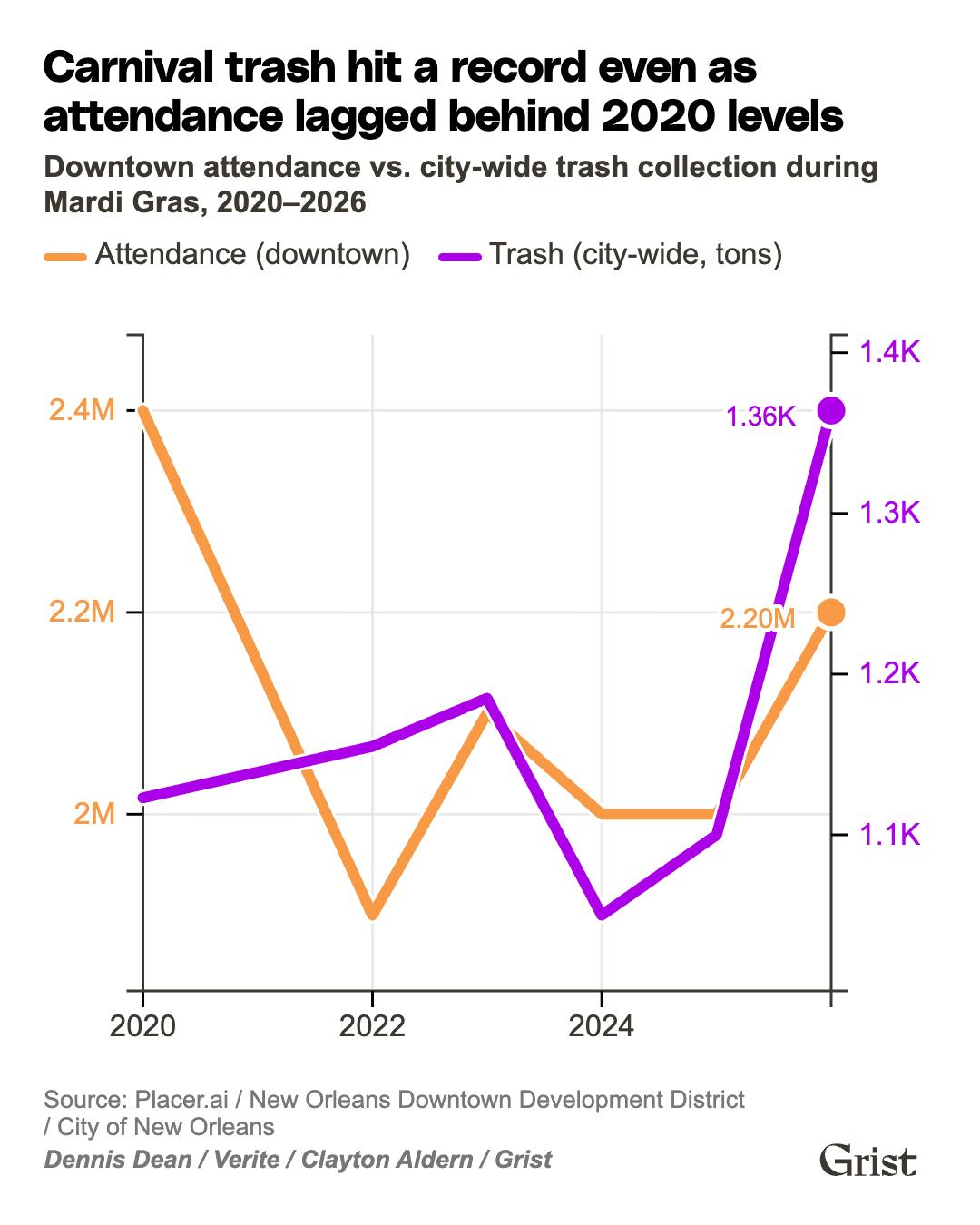
City officials initially attributed the surge in rubbish to the increased popularity of this year’s festivities. The Carnival season, which spanned from January 6 to February 17, featured over 30 float parades. The Downtown Development District reported that an estimated 2.2 million people visited downtown New Orleans during this period, representing a nearly 10 percent increase compared to the previous year. Matt Torri, the city’s sanitation director, informed the City Council in March that the rise in waste was "directly associated with the larger crowds." He added, "Anybody who was out at this year’s parades definitely took note that there seemed to be more people enjoying the Carnival season, which is great for the city."
However, an in-depth analysis by Verite News of annual attendance figures and city cleanup records reveals a more complex picture, suggesting that crowd size is not the sole determinant of waste tonnage. Over the past decade, Mardi Gras waste has shown a consistent upward trend, irrespective of year-to-year fluctuations in attendance. For instance, the 2020 Mardi Gras season drew a larger crowd of approximately 2.4 million attendees but generated roughly 241 fewer tons of garbage compared to the current year’s figures.
In the early 2010s, Mardi Gras trash tonnage generally hovered around 880 tons. This figure saw a significant spike in 2017, exceeding 1,320 tons, and has consistently remained above 1,000 tons since then. The sole exception to this trend was in 2021, when the city canceled most Carnival festivities due to the COVID-19 pandemic, resulting in no recorded trash from parades.
A Timeline of Escalating Waste:
- Early 2010s: Mardi Gras trash tonnage typically ranged around 880 tons annually.
- 2017: A notable surge, with waste exceeding 1,320 tons.
- 2018: Discovery of 46 tons of Mardi Gras beads in clogged storm drains, highlighting infrastructure impact.
- 2020: A peak in attendance (approx. 2.4 million) but less trash than current figures.
- 2021: Parades canceled due to COVID-19, resulting in negligible trash from festivities.
- Present Year: Record 1,363 tons of trash collected, a 24% increase from the prior year.
Beyond the Throws: A Deeper Dive into Contributing Factors
While the city’s sanitation director pointed to crowd size, a Verite News analysis of attendance and waste data indicates that the relationship is not straightforward. Since 2020, when the Downtown Development District began tracking visits to the Central Business and Warehouse districts, annual attendance has remained within a relatively narrow band of 1.9 to 2.4 million. Despite this consistency, the amount of trash collected has varied significantly, suggesting that other factors are at play.
The office of Mayor Helena Moreno and the city’s sanitation department did not respond to requests for comment regarding the escalating waste issue.
The persistent problem of parade trash continues to pose a significant threat to New Orleans’ drainage system. Following the 2018 bead blockage incident, the city implemented temporary filter devices, known as "gutter buddies," at catch basins along parade routes. However, conservation groups argue that these measures are insufficient, as litter continues to be discharged into the city’s canals and Lake Pontchartrain during the Carnival season.
Paradoxically, the rise in overall trash tonnage is occurring concurrently with a noticeable trend toward waste reduction within the Mardi Gras celebration itself. Many parading organizations, or krewes, have actively reduced their distribution of plastic beads and other less desirable "junk" throws. Instead, they are opting for more durable and higher-value items such as socks, baseball caps, wooden cooking spoons, and metal drinking cups. Grounds Krewe and other environmental groups have also expanded their recycling initiatives, establishing collection points for bottles, cans, and reusable throws, and engaging volunteers to sort through parade debris. This year, these efforts successfully diverted approximately 28 tons of material from landfills.
Despite these positive steps, the city’s support for recycling programs has diminished due to budget constraints. Grounds Krewe founder Brett Davis noted that even if the city had allocated the initially earmarked $200,000 for recycling, it "is not going to reverse the 24 percent gain" in waste.
An earlier hope for curbing the volume of throws stemmed from rising prices of beads and other trinkets, driven by inflation and tariffs on imports from China, a primary manufacturing source. Anecdotal evidence and social media commentary suggested a shift, with some parade-goers complaining about "stingier" krewes. However, Davis expressed perplexity: "All that is happening, with people throwing fewer beads and a lot of krewes switching to higher-quality throws, but waste is still going upward."
The "Krewe of Chad" Phenomenon and Shifting Enforcement Priorities
This perplexing trend has led experts like Davis to look beyond the throws themselves and consider the behavior of the attendees. A growing consensus among Davis and some city officials points to a significant increase in the amount of personal gear and provisions brought by revelers to secure prime parade viewing spots. These attendees are arriving earlier, staying longer, and setting up elaborate encampments. This includes items like folding chairs, canopy tents, coolers, grills, and even wagons filled with food. Many also erect temporary structures, install portable toilets, and bring generators and even discarded furniture. As the Carnival season concludes, a substantial portion of this gear is left behind, often broken, soiled, or deemed too cumbersome to transport home.
These abandoned items, ranging in weight from a few pounds for a folding chair to hundreds of pounds for a couch, represent a substantial burden for cleanup crews. City Council President JP Morrell articulated this concern, stating, "The reality is that they get their use out of this stuff, and then it becomes a tremendous amount of debris that our workers have to deal with because these people had no intention of ever picking this stuff up." He characterized this behavior as stemming from "a sense of abject entitlement—that our entire city exists to serve other people’s whims."
This phenomenon of claiming public space has given rise to the informal designation of the "Krewe of Chad," named after a viral incident in 2013 where the name was spray-painted across a patch of grass. These individuals, whom Morrell refers to as "Chadders," appear to be emboldened by a perceived decrease in the enforcement of city parade rules. While regulations officially restrict early setup to four hours before a parade, this rule is frequently disregarded. In 2024, the list of prohibited items expanded to encompass many of these common encampment elements, such as tents and tarps. A crackdown that year, involving the seizure of numerous encampment items, appeared to temporarily alter behavior.
However, the following year, the city announced a scaling back of enforcement, prioritizing security in the wake of a tragic terror attack on Bourbon Street on New Year’s Day that claimed 14 lives. Further reductions in enforcement have been necessitated by the city’s current budget crisis. Amidst significant layoffs and cost-cutting measures aimed at addressing a $220 million deficit, Morrell conceded that efforts to clear Carnival encampments would be "spotty."
"How are they going to enforce it? Well, to be honest, we’re hard up for cash," Morrell stated in an early February Instagram post. He acknowledged that police and other city departments would "do their best," but enforcement would not be as "robust as it could be."
Sanitation Director Torri explained that the city’s capacity to clear large items was limited to a single day before the final cleanup on Fat Tuesday. He described Mardi Gras Day as "a major undertaking," with crews working from 8 a.m. until 1 a.m. "It’s a full day of cleaning because of everything that people have brought. Tarps, ladders, tents, coolers, grills are left because they’re disposable things that were only intended to last the weeks of Mardi Gras."
The Path Forward: Enforcement and Sustainability
Davis anticipates that the trend toward fewer but higher-quality throws will continue. His organization remains committed to advocating for increased reuse and recycling. However, he emphasizes that policies aimed at curbing parade encampments and the waste they generate are only effective if rigorously enforced.
"Having the krewes throw less is great, but what’s really heavy is a couch and all the stuff people brought out in wheelbarrows," Davis stated. "Unless we have police out there and the trucks to haul it away, this kind of behavior creeps back. And that’s what we’re seeing now."
The challenge for New Orleans lies in balancing the vibrant cultural tradition of Mardi Gras with the urgent need for environmental stewardship and responsible public space management. Addressing the escalating waste crisis will require a multifaceted approach, encompassing continued public education, robust enforcement of encampment regulations, and sustained investment in waste reduction and recycling infrastructure. The city’s ability to effectively manage these interconnected issues will ultimately determine the long-term sustainability of its beloved celebration.