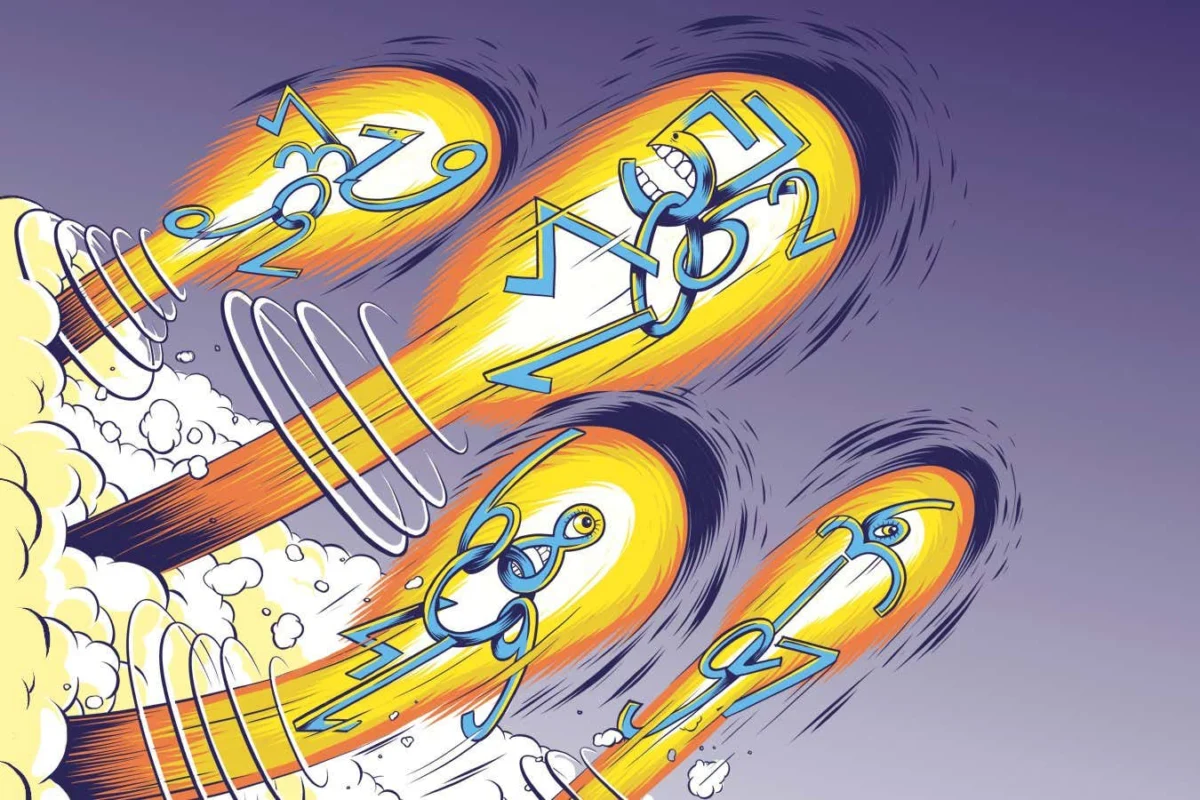
The seemingly simple sequences of multiplication and addition, when pushed to their extreme, can generate numbers of unimaginable magnitude, challenging the very foundations of mathematics and demanding entirely new levels of logical rigor. This exploration into the outer limits of numerical growth has revealed processes that vastly outpace the speed of exponential growth, even outstripping the famed growth of Sessa’s legendary chessboard of rice. These discoveries are not mere mathematical curiosities; they are fundamental to our understanding of the logical underpinnings of numbers and have significant implications for the future of mathematical logic and computer science.
The history of mathematics is replete with instances of scholars grappling with numbers far beyond any immediate practical application. Ancient Babylonian astronomers meticulously calculated values like 9¹¹ x 12³⁹, quantities exceeding the number of atoms in Earth. Archimedes famously attempted to quantify the number of grains of sand that could fill the universe. The classical Maya civilization contemplated timescales of octillions of years, dwarfing the current age of the cosmos. These historical precedents underscore a persistent human fascination with the immense, a drive to comprehend the boundless, even when it transcends our tangible reality.
This fascination with "huge numbers," as explored in Richard Elwes’s book of the same name, has recently led mathematicians to confront a more contemporary, yet equally profound, challenge: the inherent speed limits within arithmetic itself. The very fabric of mathematical proof, the bedrock of our most solid knowledge, relies on a set of fundamental assumptions known as axioms. The late 19th century saw logicians like Giuseppe Peano meticulously formalizing the axioms of arithmetic, laying the groundwork for our understanding of natural numbers, succession, addition, subtraction, multiplication, and division. Peano’s axioms, though seemingly elementary, proved to be the cornerstone of arithmetic, establishing a system that, for centuries, appeared robust and self-contained.
However, the seemingly straightforward progression of arithmetic was irrevocably altered by Kurt Gödel’s groundbreaking incompleteness theorems in 1931. Gödel’s work demonstrated that no single, comprehensive rulebook, or set of axioms, could ever fully capture all true statements about arithmetic. This revelation meant that within any sufficiently complex axiomatic system, there would always exist true statements that could not be proven from those axioms. While initially a theoretical bombshell, for decades, these limitations seemed confined to esoteric logical constructions, far removed from the practical concerns of everyday mathematics.
The Emergence of Hyper-Accelerating Sequences
The notion that arithmetic itself possesses a "speed limit" stems from the structure of Peano’s axioms. For most of mathematical history, this limit was so astronomically high that it posed no practical obstacle. However, this began to change with the discovery of sequences that grew at rates previously thought impossible within the confines of standard arithmetic.

The Goodstein Metasequence: A Glimpse Beyond the Limit
A pivotal moment arrived in the 1940s with Reuben Goodstein’s discovery of a remarkable sequence. Starting with an arbitrary integer, say 19, Goodstein devised a process involving base-2 representation and iterative transformations. The initial number, 19, is expressed in base 2 as 2⁴ + 2¹ + 1. To ensure that only digits 1 and 2 appear in the representation, the exponents themselves are rewritten in base 2. Thus, 2⁴ becomes 2²², and the initial expression transforms into 2²² + 2 + 1.
The core of Goodstein’s process involves two steps: first, replace every instance of the digit ‘2’ with ‘3’; second, subtract 1 from the resulting number. Applying this to our example, 3³³ + 3 – 1. The next step involves replacing every ‘3’ with a ‘4’ and subtracting 1, yielding 4⁴⁴ + 4 – 1. This iterative process generates a sequence that grows with astonishing speed. The first few terms are 19, followed by a number exceeding 7 trillion, and then a number with over 10 million digits.
While this demonstrates rapid growth, Goodstein’s truly revolutionary finding in 1944 was that, regardless of the starting number, this sequence would eventually stabilize and return to zero. This was a profound revelation, as it suggested a finite process within what appeared to be unbounded growth. For smaller starting numbers, this convergence is rapid. For instance, starting with 3, it takes only six steps to reach zero. However, for a starting number like 4, the journey to zero requires more than 10¹⁰⁰,⁰⁰⁰,⁰⁰⁰ steps, a number so vast it dwarfs any conceivable physical quantity.
The sequence of the lengths of these Goodstein sequences is known as the Goodstein metasequence. The sixth entry of this metasequence, corresponding to the length of the Goodstein sequence starting from 6, is a number so immense that it defies conventional description. Even Donald Knuth, a renowned explorer of large numbers, described such magnitudes as "beyond comprehension." To represent this number using a tower of exponentials (e.g., 10¹⁰¹⁰), the tower of 10s would need to be so tall that its height could only be described by another tower of exponents, repeating this process for longer than the age of the universe. This remarkable sequence thus demonstrably breaches the speed limit imposed by Peano’s arithmetic.
Reverse Mathematics and the Graph Minor Theorem
The implications of Goodstein’s work extended beyond mere numerical curiosity. In 1982, Jeff Paris and Laurie Kirby employed a field known as "reverse mathematics." Instead of starting with axioms and deriving theorems, they began with a theorem – Goodstein’s proof that the sequence always returns to zero – and investigated the minimal set of axioms required to prove it. Their crucial finding was that Peano’s axioms alone were insufficient. This was a landmark discovery, providing the first concrete example of Gödel’s incompleteness theorems manifesting in a widely applicable mathematical theorem, not through contrived logical trickery, but through natural mathematical reasoning.

This opened the door to a new era of mathematical research, spearheaded by the logician Harvey Friedman, known as reverse mathematics. This field systematically explores the axiomatic strength needed to prove various mathematical statements. One of the most spectacular outcomes of this program was its application to the graph minor theorem.
Proved over two decades by Neil Robertson and Paul Seymour through a series of 20 technical papers (1983-2004), the graph minor theorem is a monumental achievement in modern mathematics. It deals with graph theory, a field that studies abstract networks of nodes connected by edges. These structures are ubiquitous, appearing in fields ranging from molecular chemistry to the intricate architecture of the World Wide Web.
A "minor" of a graph is a smaller graph that can be obtained from the larger one through a series of operations: deleting edges, deleting nodes (along with their incident edges), or contracting edges (merging two nodes connected by an edge). The graph minor theorem states that for any given graph, it is impossible to construct an infinite sequence of graphs such that no graph in the sequence is a minor of another. In essence, any infinite collection of finite graphs must eventually contain a pair where one is a subgraph of the other in this specific "minor" sense.
This theorem has profound implications. It provided a powerful framework for understanding the structure and complexity of abstract networks. Its development spurred the creation of "structural graph theory," a subfield that offers robust tools for analyzing complex systems, from transportation networks to power grids.
Breaking the Arithmetical Barrier
Crucially, the graph minor theorem, despite its visual representation involving diagrams, is fundamentally grounded in arithmetic. Its proof, however, requires axiomatic systems that extend beyond the basic framework established by Peano. When Friedman collaborated with Robertson and Seymour, they demonstrated that proving the graph minor theorem necessitates axiomatic principles that lie significantly beyond standard arithmetic. This meant that the logical machinery required to establish its truth was far more complex than that needed for Goodstein’s metasequence.

In 2006, this research led Friedman to discover one of the fastest-growing sequences known in mainstream mathematics. To comprehend the sheer magnitude of these numbers, mathematicians categorize axiomatic systems into hierarchical levels. Peano’s axioms represent level three. Above this lie systems like "arithmetical transfinite recursion" and "₁₁ comprehension," which involve concepts of sets and their properties. These higher levels of axioms grant greater logical power, enabling the handling of increasingly complex mathematical structures and, consequently, faster-growing sequences.
The graph minor theorem, remarkably, transcends all five of these standard axiomatic levels. In 2019, Michael Rathjen and his student Martin Krombholtz at the University of Leeds investigated the precise axiomatic strength required to accommodate the graph minor theorem and its associated colossal sequences. Their findings indicated that it requires systems two levels beyond the standard five – a realm of logic designed for "mathematical rocket ships," far exceeding the needs of most mainstream mathematical activities.
The Deep Dive: Subcubic Graph Sequence
The concept of the subcubic graph sequence, discovered through this line of inquiry, exemplifies the extraordinary growth rates observed. This sequence explores the maximum length of a list of graphs with specific properties, where no graph in the list is a minor of another.
SCG(0): The Baseline
Consider the challenge of creating a list of subcubic graphs (graphs where each node has at most three edges connected to it) with the following rules:
- The first graph can have at most one node.
- The second graph can have at most two nodes.
- The third graph can have at most three nodes, and so on.
- Crucially, no graph in the list can be a "minor" of any subsequent graph.
The surprising result is that the longest possible list under these conditions contains exactly six graphs. The final graph in this list is the "empty graph," devoid of nodes and edges. This maximum length is denoted as SCG(0) = 6.

SCG(1): The Accelerated Growth
Now, let’s adjust the rules slightly. We grant ourselves a head start:
- The first graph can have at most two nodes.
- The second graph can have at most three nodes.
- The third graph can have at most four nodes, and so forth.
All other rules, including the "no minor" constraint, remain the same. The question is, what is the longest list we can construct now? This length is referred to as SCG(1).
The progression of these lengths, SCG(0), SCG(1), SCG(2), and so on, constitutes the subcubic graph sequence. While all these puzzles have finite solutions, the resulting numbers are staggeringly large. Even SCG(1) dwarfs the 19th entry of the Goodstein metasequence, a number already far beyond normal arithmetic’s speed limit. The complexity and sheer scale of these numbers underscore the fact that our most advanced mathematical understanding of networks, seemingly simple collections of dots and lines, pushes the boundaries of what can be formalized within the established axioms of arithmetic.
Broader Implications and Future Directions
The exploration of these hyper-accelerating sequences challenges our intuition about the relationship between simplicity and complexity in mathematics. While many complex mathematical objects can ultimately be traced back to the foundational axioms of arithmetic, the discovery that fundamental areas like structural graph theory require significantly more elaborate axiomatic systems is a profound development. It highlights that truly irreducible complexity, where elaborate infinite sets are essential to mathematical proofs and structures, is rarer but exists in critical domains.
This ongoing research into the speed limits of arithmetic and the axiomatic requirements of various mathematical theorems has far-reaching implications. It not only deepens our understanding of the logical foundations of mathematics but also informs the development of computational complexity theory. As we push the boundaries of what can be computed and proven, understanding these inherent limitations and the axiomatic frameworks they necessitate becomes increasingly vital for fields like artificial intelligence, theoretical computer science, and the design of robust mathematical software. The quest to understand these "huge numbers" continues, promising further revelations about the fundamental nature of logic, computation, and the universe of mathematics itself.