Grasslands, wetlands, savannas, and other nonforest ecosystems are disappearing due to agricultural expansion at a rate four times faster than forests, yet they remain largely unaddressed by Europe’s landmark anti-deforestation law and other significant environmental policies. This critical oversight, detailed in a new report by the Rainforest Alliance, World Resources Institute (WRI), and partner organizations, highlights a substantial gap in global conservation efforts, potentially jeopardizing biodiversity, carbon sequestration, and the livelihoods of communities reliant on these vital natural landscapes.
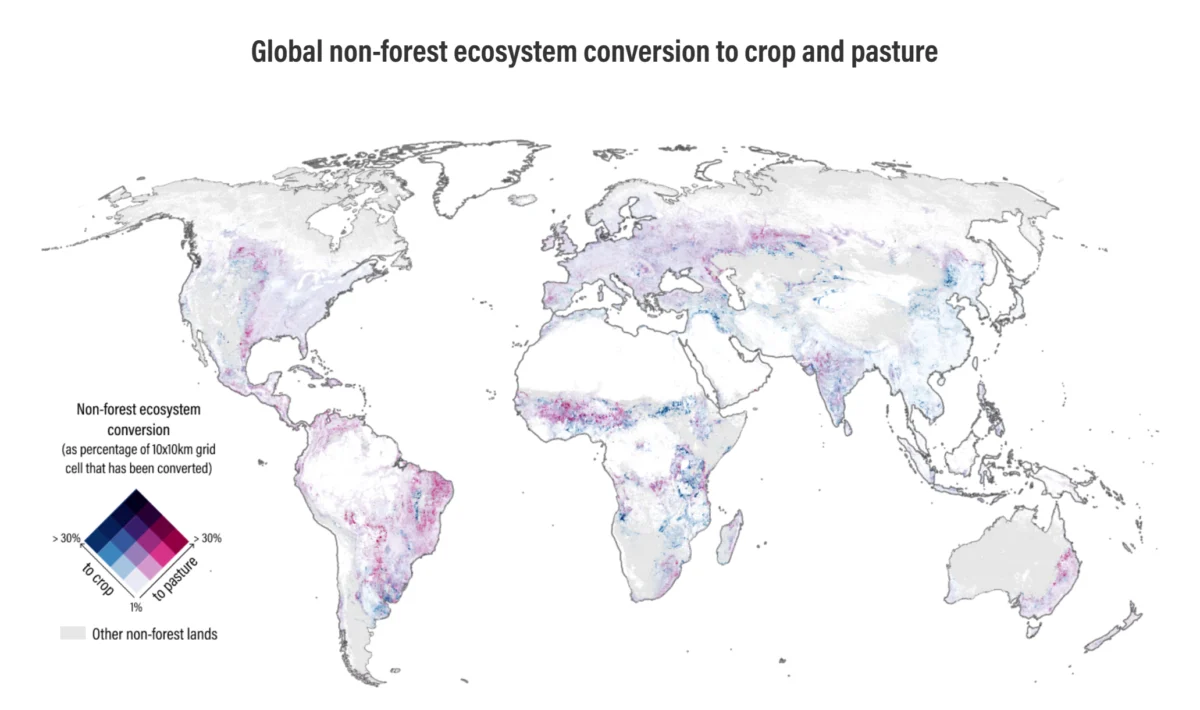
The comprehensive analysis reveals that between 2005 and 2020, approximately 190 million hectares (470 million acres) of nonforest natural ecosystems worldwide were converted primarily into agricultural land, including pastures and farms. This vast area is comparable in size to Mexico, underscoring the sheer scale of this overlooked environmental crisis. This rate of conversion significantly outpaces that of forests, which have historically received greater attention and policy focus.
The Shifting Pressure: From Forests to Forgotten Ecosystems
The report’s findings suggest a concerning trend: as protections around forests tighten, agricultural pressures are increasingly redirected towards other ecologically significant, but often less regulated, natural environments. Siyi Kan, an environmental economics researcher at the University of Oxford, emphasized this point in an email correspondence with Mongabay. "When protections tighten around forests, agricultural pressure can shift into other natural ecosystems that are also ecologically important but often much less protected," Kan stated. "We need to start paying attention to them now, before it is too late."
Both forest and nonforest ecosystems play crucial roles in maintaining global biodiversity and acting as vital carbon sinks, essential for mitigating climate change. However, Kan pointed out that the majority of existing policy frameworks and corporate sustainability commitments disproportionately concentrate on forest protection, leaving other critical biomes vulnerable.
Global Hotspots of Nonforest Ecosystem Conversion
The study identified Brazil as the country experiencing the most extensive conversion of nonforest ecosystems to agriculture during the 15-year period from 2005 to 2020. This was followed by China, Russia, and the United States, indicating a widespread global challenge that transcends specific continents or economic development levels. The expansion of agricultural frontiers, driven by demand for commodities like soy, beef, and palm oil, appears to be a primary driver behind this conversion.

The implications of this widespread conversion are profound. The loss of grasslands can lead to soil degradation, reduced water retention, and the extinction of specialized flora and fauna. Wetlands, crucial for flood control, water purification, and as nurseries for aquatic life, are equally vulnerable. Savannas, often rich in biodiversity and playing a significant role in carbon storage, also face immense pressure from agricultural expansion.
Europe’s Anti-Deforestation Law: A Blind Spot for Nonforest Ecosystems
Europe’s flagship regulation to combat deforestation, the EU Deforestation Regulation (EUDR), aims to ensure that certain agricultural commodities entering the EU market are not linked to recent deforestation. Commodities covered include palm oil, cattle, coffee, cocoa, soy, wood, and rubber. However, the EUDR relies on the United Nations Food and Agriculture Organization’s (FAO) definition of a forest, which typically requires trees to be taller than five meters. This definition inadvertently excludes many vital nonforest ecosystems, such as vast areas of savannas, peatlands, and grasslands, from the regulation’s purview.
This exclusion has drawn criticism from environmental organizations and Indigenous leaders who advocate for broader protections. In 2024, a coalition of non-profit organizations and Indigenous leaders urged European politicians to include Brazil’s Cerrado savanna within the scope of the EUDR during its review process. The Cerrado, a biodiverse tropical savanna ecoregion, has faced significant agricultural encroachment, particularly for soy production, despite the looming EUDR.
Delays and Loopholes: Weakening the Impact of EUDR
Despite calls for expansion and a clear need for broader protection, European lawmakers have not yet broadened the definition of covered ecosystems in the EUDR. Furthermore, the implementation of the regulation has been plagued by repeated delays. Initially slated to take effect earlier, the EUDR has been postponed twice, now scheduled to commence on December 31, 2026. These delays have allowed for the introduction of several exceptions and loopholes within the legislation, which conservationists argue significantly weaken its effectiveness.
The extended timeline for the EUDR’s implementation means that a substantial period of agricultural expansion could occur without the direct regulatory oversight intended by the law. This delay, coupled with the exclusion of critical nonforest ecosystems, creates a precarious situation where the very ecosystems most rapidly disappearing are left largely unprotected by one of the world’s most significant environmental policies.
Siyi Kan expressed concern about the political and practical challenges associated with expanding the EUDR’s scope. "Unfortunately, even the forest-focused regulation has faced repeated delays in implementation, so expanding its scope to other ecosystems will likely be politically and practically even more difficult," Kan commented. "Still, that should not be a reason to ignore these ecosystems."

The Broader Implications: Biodiversity, Climate, and Sustainable Development
The continuous conversion of nonforest ecosystems has far-reaching consequences beyond the immediate loss of habitat.
- Biodiversity Loss: These ecosystems often harbor unique and endemic species that are specifically adapted to their environments. Their destruction leads to habitat fragmentation and loss, pushing numerous species towards extinction. The Cerrado, for example, is a global biodiversity hotspot, home to an array of unique plants and animals.
- Carbon Emissions: While forests are well-known carbon sinks, grasslands and wetlands also play a significant role in carbon sequestration. The degradation and conversion of these ecosystems release substantial amounts of stored carbon into the atmosphere, exacerbating climate change. Peatlands, in particular, store vast quantities of carbon accumulated over millennia.
- Water Security: Wetlands and grasslands are vital for regulating water cycles, filtering water, and preventing floods. Their destruction can lead to increased drought, water scarcity, and reduced water quality for both ecosystems and human populations.
- Livelihoods and Food Security: Many communities, including Indigenous peoples, rely directly on the resources and services provided by nonforest ecosystems for their sustenance and livelihoods. Their conversion can disrupt traditional practices, leading to social and economic instability, and potentially impacting global food security through the loss of productive, naturally balanced landscapes.
A Call for Integrated Policy and Action
The findings of the report by the Rainforest Alliance, WRI, and partners serve as a stark warning. The current approach to environmental protection, heavily focused on forests, is insufficient to address the full spectrum of ecological degradation driven by agricultural expansion.
There is an urgent need for a paradigm shift in environmental policy and corporate sustainability efforts to encompass all vital natural ecosystems. This includes:
- Expanding Regulatory Definitions: Policymakers, particularly in regions like the European Union, must reconsider and broaden the definitions of "deforestation" and "natural ecosystems" in regulations to include grasslands, savannas, wetlands, and peatlands.
- Enhanced Monitoring and Enforcement: Robust systems for monitoring land-use change across all ecosystem types are required, coupled with stringent enforcement mechanisms to prevent illegal conversion.
- Support for Sustainable Land Management: Incentives and support should be provided for sustainable agricultural practices that minimize land conversion and promote ecosystem restoration in affected areas.
- Increased Transparency and Supply Chain Accountability: Companies must implement comprehensive due diligence processes that extend beyond forest-related risks to include the impacts on all natural ecosystems within their supply chains.
- Empowering Local Communities: Recognizing and supporting the rights and traditional knowledge of Indigenous peoples and local communities, who are often the frontline stewards of these ecosystems, is crucial for effective conservation.
The escalating rate of nonforest ecosystem conversion represents a silent crisis that demands immediate and comprehensive attention. Failure to act decisively could have irreversible consequences for global biodiversity, climate stability, and the well-being of countless communities worldwide. The momentum built around forest protection must now be channeled and expanded to safeguard the full array of Earth’s invaluable natural heritage.
Banner Image: Capybaras (Hydrochoerus hydrochaeris) in the Pantanal wetland in Brazil. Image © Diego Baravelli/Greenpeace.