
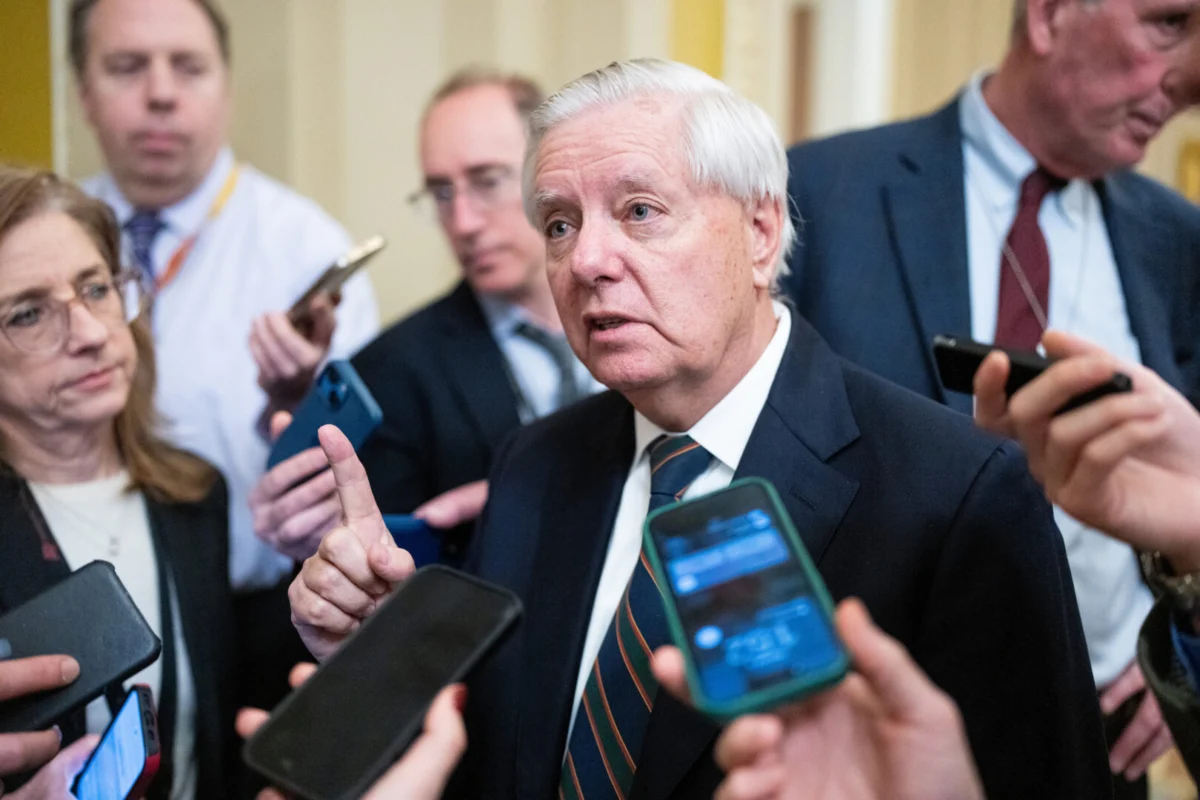
The United States Senate voted Tuesday to advance a budget resolution, a critical legislative maneuver designed to secure substantial funding for immigration enforcement agencies, including Immigration and Customs Enforcement (ICE) and U.S. Customs and Border Protection (CBP), through the remainder of President Donald Trump’s term. This procedural vote, strictly along party lines with 52 Republicans supporting and 46 Democrats opposing, marks the initial step in a complex budget reconciliation process that the Republican majority aims to utilize to bypass anticipated Democratic opposition to comprehensive immigration enforcement funding, particularly in the absence of new federal oversight or "guardrails" for agents.
The Reconciliation Path: Bypassing Gridlock
Budget reconciliation is a special legislative procedure under the Congressional Budget Act of 1974 that allows certain budget-related legislation to pass the Senate with a simple majority (51 votes) rather than the usual 60-vote threshold required to overcome a filibuster. This mechanism is typically employed for tax, spending, and debt limit legislation and is subject to strict rules, most notably the "Byrd Rule," which prohibits extraneous provisions unrelated to the budget. Republicans, facing a deeply divided Congress and persistent partisan stalemates over immigration policy, are leveraging this tool to push through their agenda. The 52-46 vote underscores the deep ideological chasm separating the two parties on immigration, particularly concerning border security and the operational scope of enforcement agencies.
The proposed fiscal 2026 budget resolution, a framework for future spending, outlines specific instructions for congressional committees. It mandates that both the Senate Homeland Security and Governmental Affairs Committee and the Senate Judiciary Committee, as well as their counterparts in the House, the House Homeland Security Committee and the House Judiciary Committee, draft reconciliation legislation by May 15. This legislation is intended to appropriate up to $70 billion, a sum projected to sustain the operations of key immigration agencies for approximately three and a half years. This multi-year funding approach is a deliberate attempt to provide long-term stability for enforcement efforts, insulating them from annual appropriations battles that often become hostage to broader political disagreements.
Funding Details and Congressional Mandates
The resolution’s instructions initially appeared to allow for a potential increase in the deficit by up to $70 billion for each of the two Senate authorizing committees, theoretically permitting a total of $140 billion in new spending. However, Taylor Reidy, spokeswoman for Senate Budget Chairman Lindsey Graham, clarified via social media that the matching instructions were designed to provide "maximum flexibility" given the overlapping jurisdictions of the committees on immigration policy. She affirmed that the GOP’s overarching spending target for immigration enforcement would remain at approximately $70 billion. This clarification was crucial to avoid misinterpretations about the scale of the proposed funding and to manage expectations among fiscal conservatives within the Republican caucus.
The substantial funding, if enacted, would represent a significant investment in the infrastructure and personnel of ICE and CBP. Historically, funding for these agencies has been a contentious point. In fiscal year 2018, for instance, CBP received over $15 billion, and ICE received around $8 billion, highlighting the already considerable financial commitment to border security and interior enforcement. The proposed $70 billion over 3.5 years would average out to roughly $20 billion annually, a considerable increase that reflects the Trump administration’s "America First" agenda and its strong emphasis on border security and interior immigration enforcement.
Republican Rationale and Strategic Imperatives
Senator Lindsey Graham, a Republican from South Carolina and the Chairman of the Senate Budget Committee, articulated the urgency behind the resolution. "Republicans are doing something that must be done quickly, and that our Democrat colleagues are trying to prevent us from doing," Graham stated. He emphasized that the resolution represented a proactive step "moving forward – not backward – on rational immigration policies that secure our border." This statement reflects the GOP’s long-standing argument that robust border enforcement is a national security imperative and a necessary prerequisite for any broader immigration reform discussions.
The push for a reconciliation bill is also inextricably linked to the ongoing political standoff surrounding the funding of the Department of Homeland Security (DHS). At the time of this vote, a record-breaking partial government shutdown was in effect, largely due to disagreements over border wall funding and broader immigration enforcement. Senate GOP leaders expressed a desire to keep the reconciliation bill narrowly focused on immigration funding to enhance its chances for swift passage. Their strategic hope was that by securing funding for ICE and Border Patrol through reconciliation, it could "clear a path" for fully funding the rest of DHS, thereby bringing an end to the partial shutdown that had impacted hundreds of thousands of federal workers and critical government operations.
The "Vote-a-Rama" and Potential Expansion
Despite the Republican leadership’s intention to keep the reconciliation package narrow, the legislative path is fraught with potential diversions. The budget resolution will be subject to an unlimited series of amendment votes on the Senate floor, a marathon session colloquially known as a "vote-a-rama." This process, which could commence as early as Wednesday night or Thursday, depending on senators’ use of the allotted 50 hours of debate time, carries the inherent risk of expanding the scope of the reconciliation package. During a vote-a-rama, senators from both parties often introduce amendments not necessarily to pass them, but to force politically difficult votes, highlight policy differences, or simply make a political statement.
Following a Tuesday morning huddle in Senator Graham’s office, Senate Budget Republicans largely voiced support for prioritizing a focused package centered solely on immigration enforcement funding. However, some members harbored aspirations for a subsequent reconciliation package later in the year, which could encompass a broader array of legislative items. These ranged from increases in defense spending to potential cuts in health care spending, demonstrating the ongoing internal debates within the GOP about fiscal priorities and the strategic use of reconciliation. Finance Chairman Michael D. Crapo, a Republican from Idaho, affirmed his support for the immediate strategy: "I do agree with the general strategy of moving ahead quickly on funding ICE and Border Patrol, and that’s what I’m going to support."
Democratic Opposition and Counter-Strategies
Democrats, keenly aware of the political implications and policy ramifications, were preparing a robust counter-offensive. Their planned amendments were expected to include proposals for restrictions on ICE operations, but their primary focus was on "affordability issues." Senator Brian Schatz, a Democrat from Hawaii, articulated this strategy: "We’re going to focus almost exclusively on the cost of living. And we’re going to make the point that they have this extraordinary tool, and they’re using it to pre-fund ICE with no reforms, rather than to reduce the cost of gasoline and electricity and groceries and health insurance." This approach aimed to frame the Republican initiative as a misallocation of resources, arguing that reconciliation, a powerful legislative tool, should be used to address everyday economic concerns of American families rather than exclusively for immigration enforcement without accompanying reforms.
Democrats also expressed enthusiasm about pressing Republicans on potential restrictions on immigration agents, such as prohibiting the wearing of masks during raids or requiring judicial warrants for entry into private property. Republicans have historically resisted such restrictions, arguing that they would "hamstring" ICE operations, compromise agent safety, and expose personnel to doxing and intimidation. Senate Appropriations ranking member Patty Murray, a Democrat from Washington, encapsulated the Democratic critique in a statement: "Instead of doing literally anything to lower costs, Republicans are spending their time working hard to cut another massive blank check for ICE and Border Patrol — without any reforms, or even basic guardrails." This statement highlights a fundamental disagreement over the balance between enforcement powers and civil liberties.
The Executive Branch’s Stance and Congressional Divisions
The executive branch, under President Trump, had set a deadline of June 1 for Republicans to pass a reconciliation bill funding immigration agencies, emphasizing the administration’s determination to see this legislation through. However, the path to passage required nearly every Republican member in both chambers to overcome united Democratic opposition, a challenging prospect given the slim majorities.
The broader funding of the Department of Homeland Security was also intertwined with this reconciliation effort. The Senate had already passed a separate bill funding the majority of DHS, excluding the immigration agencies. However, House leaders, particularly Speaker Mike Johnson, a Republican from Louisiana, had been reluctant to take up that bill until the reconciliation bill secured immigration funding. "The sequencing is important," Johnson stated, expressing concern that if the bulk of the department were funded first, key immigration agencies could be "left out" or "made an orphan." This highlights the tactical considerations and the intricate legislative dance between the two chambers and the White House.
Adding another layer of complexity were divisions within the House GOP’s right flank. Some members remained resistant to the two-pronged approach for funding the department. Representative Chip Roy, a Republican from Texas and a prominent member of the ultraconservative Freedom Caucus, voiced his skepticism: "I haven’t said what I will do or not do. But I think marching to the beat… of the Democratic drum is insane. That we would isolate Border Patrol and ICE, I think is crazy." This sentiment reflects a desire among some conservatives for a more comprehensive approach to border security, possibly including funding for a border wall, rather than a piecemeal solution.
Broader Political and Fiscal Implications
Beyond the immediate legislative objectives, the use of reconciliation for immigration funding carried significant political and fiscal implications. There was a palpable concern within the Republican party that the package, if kept too narrow, might represent a missed opportunity. Some believed this could be their "last chance" to move filibuster-proof legislation before the November midterm elections, where they faced the risk of losing their fragile majorities in both chambers. This perspective underscored the high stakes of the legislative calendar and the pressure to deliver on key promises to their base.
While some Republicans desired to include spending cuts as part of a reconciliation package, some fiscal hawks argued that such cuts were not strictly necessary for an immigration-enforcement-only funding package. Their rationale was that this funding was intended to replace annual appropriations that would not have been offset, thus not adding new "unaccounted for" spending. However, the appetite for deficit reduction remained strong among certain members. Senator Rick Scott, a Republican from Florida and a member of the Budget Committee, indicated his intention to push for potential deficit reduction measures, or "pay-fors," in the reconciliation bill. When pressed on his confidence in securing such measures, Scott offered a dose of political realism: "I haven’t had a lot of success since I’ve been up here. I’m an optimist, but I have to be realistic." His comments highlight the perennial challenge of identifying and agreeing upon spending offsets in a politically charged environment.
Historical Context: The Long Shadow of Immigration Debates
The debate over funding immigration enforcement is not new. For decades, immigration has been a deeply divisive issue in American politics, frequently leading to legislative gridlock. The creation of DHS in 2003, consolidating various border and immigration agencies, aimed to improve coordination, but funding and policy disputes have persisted. From debates over comprehensive immigration reform under Presidents Bush and Obama to the highly politicized calls for a border wall under President Trump, the nation has consistently grappled with how to manage its borders and enforce its immigration laws. The use of budget reconciliation itself has a controversial history, often deployed when one party holds power and seeks to enact its agenda without bipartisan support, leading to accusations of partisan overreach. This latest attempt fits squarely within this historical pattern, underscoring the enduring difficulty of forging consensus on immigration policy in the United States.
The Path Forward: Hurdles and Uncertainties
The Senate’s vote to take up the budget resolution marks the beginning of a complex and potentially protracted legislative battle. The reconciliation process, while offering a path to bypass the filibuster, is not without its own significant hurdles. The Byrd Rule, for example, could be invoked to strike down any amendments or provisions deemed extraneous to the budget. Democratic amendments during the "vote-a-rama" will test Republican unity and potentially force difficult votes. Internal divisions within the Republican party, particularly between those seeking a narrow package and those desiring broader fiscal or policy reforms, will also complicate matters. Ultimately, the success of this initiative hinges on the ability of Republican leadership to maintain party discipline, navigate procedural challenges, and secure the necessary votes in both the Senate and the House, all while facing determined opposition and an impending presidential deadline. The outcome will not only shape immigration enforcement for years to come but also set a precedent for future legislative battles in a deeply polarized Congress.
Valerie Yurk contributed to this report.