An astronaut aboard the International Space Station (ISS) captured a striking image on July 30, 2023, offering a unique perspective of the northeast quadrant of the Capital Beltway (I-495) in Maryland. The photograph, released by NASA on April 22, 2026, highlights the intricate tapestry of urban development interwoven with significant green spaces that characterize the landscape surrounding Washington, D.C. This aerial view not only showcases the geographical features of the region but also provides a visual narrative of its history, planning, and ongoing scientific endeavors.
The Capital Beltway: A Lifeline of the Metropolitan Area
The Capital Beltway, a 64-mile loop encircling Washington, D.C., serves as a critical artery for millions of commuters and travelers daily. Its vast network connects the nation’s capital with its extensive suburban sprawl across Virginia and Maryland. The particular section imaged by the astronaut passes through the historically significant city of Greenbelt, Maryland, a community with roots deeply embedded in the ambitious social and economic planning of the 1930s. The lush, verdant appearance of the landscape in the photograph is indicative of the region’s peak summer vegetation, a testament to the favorable climate and the presence of extensive natural areas.
Greenbelt Park: A Legacy of Conservation
One of the most prominent green expanses visible in the astronaut’s photograph is Greenbelt Park. This sprawling natural area, covering nearly 5 square kilometers (approximately 2 square miles), is a vital ecological and recreational resource for the surrounding communities. The park features an extensive network of forested hiking trails, numerous picnic areas, and a popular campground, offering residents and visitors opportunities for outdoor recreation and respite from urban life.
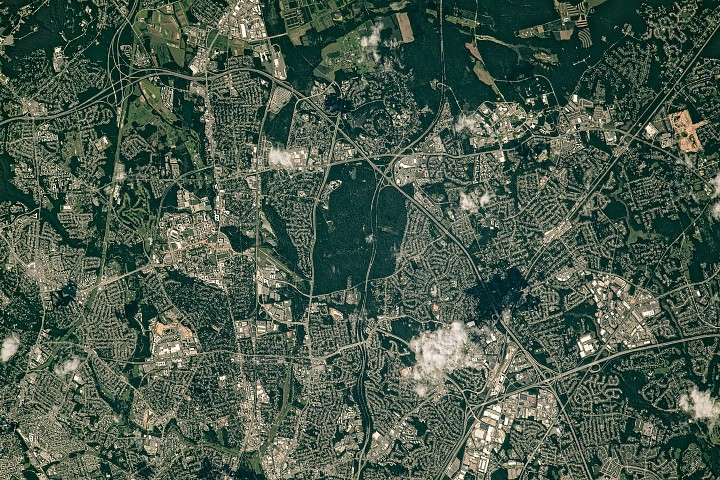
The history of Greenbelt Park is intrinsically linked to the founding of the city of Greenbelt itself. The land was originally designated for the future expansion of the city. However, in a significant shift of policy and planning, it was acquired by the National Park Service in 1950. This acquisition preserved the area as a natural landscape, a decision that has yielded immense benefits in terms of biodiversity, watershed protection, and recreational access. The park’s preservation underscores a growing recognition of the importance of integrating natural environments within increasingly developed metropolitan regions.
Greenbelt: A New Deal Community’s Enduring Vision
North of Greenbelt Park lies the city’s historic district, a testament to a unique experiment in urban planning. The district’s distinctive crescent shape is a deliberate design feature, reflecting its origins as one of three planned communities established during the Great Depression as part of President Franklin D. Roosevelt’s New Deal. These communities were conceived with a dual purpose: to provide employment opportunities for a nation grappling with high unemployment and to create affordable, cooperative housing models that emphasized a harmonious relationship between residents and their environment.
A hallmark of these New Deal communities, including Greenbelt, was the integration of pedestrian pathways and ample green space. Homes were designed to connect to walking paths, which in turn facilitated access to essential amenities, including one of the nation’s oldest planned shopping centers. This foresight in urban design aimed to foster a strong sense of community and promote a healthy, active lifestyle, principles that remain relevant in contemporary urban planning discussions. The continued existence and vibrancy of Greenbelt’s historic district offer a valuable case study in the long-term success of thoughtfully designed planned communities.
NASA’s Goddard Space Flight Center: A Hub of Scientific Innovation
Adding another layer of significance to the Greenbelt landscape is the presence of NASA’s Goddard Space Flight Center. Situated east of the Capital Beltway, this renowned facility was established on May 1, 1959, marking its distinction as NASA’s first dedicated spaceflight complex. Goddard has been instrumental in a myriad of groundbreaking scientific missions, from Earth observation and climate research to space exploration and astrophysics.
The image reveals that even within this critical scientific hub, pockets of forested land are strategically interspersed among the various buildings. This intentional landscaping likely serves multiple purposes, including aesthetic enhancement, noise reduction, and potentially as a buffer zone to minimize environmental impact.
Beltsville and College Park: Agricultural and Academic Roots
Further north of Goddard, the landscape transitions to a mix of forested areas and agricultural fields within the town of Beltsville. This region is home to significant research institutions, including the University of Maryland and the U.S. Department of Agriculture’s Beltsville Agricultural Research Center (BARC). These facilities are at the forefront of agricultural science, crop development, and environmental research, contributing vital knowledge to food security and sustainable land management. The University of Maryland’s main campus is also visible in the photograph, located just west of Greenbelt in College Park, further emphasizing the concentration of educational and research institutions in the area.
Hyattsville and the Baltimore-Washington Parkway: Networks of Greenery
The astronaut’s photograph also captures other tree-lined areas that contribute to the region’s green infrastructure. The city of Hyattsville, located south of College Park, has been recognized for its commitment to urban forestry, having been designated a "tree city" for over three decades. This ongoing dedication to tree preservation and planting enhances the urban environment, improving air quality, reducing the urban heat island effect, and providing aesthetic benefits.
Furthermore, a significant segment of the Baltimore-Washington Parkway (MD-295) is visible, characterized by its tree-lined median. This parkway, which connects Baltimore and Washington, D.C., runs north-south and bisects Greenbelt Park, creating a visual and functional link between urban centers and natural spaces. The presence of such linear green corridors is crucial for wildlife movement, ecological connectivity, and the overall aesthetic appeal of the metropolitan landscape.
The International Space Station: A Unique Vantage Point for Earth Observation
The photograph itself, ISS069-E-39302, was acquired on July 30, 2023, using a Nikon D5 digital camera with a powerful 1150-millimeter focal length lens. This telephoto capability allowed the astronaut to capture remarkable detail from the ISS’s orbital altitude. The image was provided by the ISS Crew Earth Observations Facility and the Earth Science and Remote Sensing Unit at NASA Johnson Space Center. It represents the work of the Expedition 69 crew, whose mission is dedicated to scientific research and Earth observation from space.
The image has undergone post-processing, including cropping and enhancements to improve contrast and remove lens artifacts, ensuring its clarity and scientific value. The International Space Station Program actively supports these observational efforts, recognizing the profound importance of documenting our planet from space. The images collected by astronauts and cosmonauts are invaluable resources for scientists studying Earth’s systems and for the public, fostering a greater understanding and appreciation of our home planet. These images are made freely available on the internet through NASA’s Gateway to Astronaut Photography of Earth.
Broader Implications and Future Perspectives
This astronaut photograph of Greenbelt, Maryland, serves as a powerful reminder of the complex interplay between human development and natural landscapes. It highlights the foresight of early urban planners who prioritized green spaces and the ongoing efforts of institutions like the National Park Service, NASA, the University of Maryland, and the USDA to conserve and study these vital environments.
The juxtaposition of a major transportation corridor like the Capital Beltway with extensive parkland, historic planned communities, and cutting-edge research facilities underscores the multifaceted nature of the Washington, D.C. metropolitan area. The continued success of Greenbelt Park as a natural refuge and the ongoing scientific research at Goddard and in Beltsville demonstrate the enduring value of integrating natural systems and scientific inquiry into the fabric of urban life. As metropolitan areas continue to grow, lessons learned from communities like Greenbelt, and the observational data provided by missions like the ISS, will be increasingly critical in shaping sustainable and resilient urban futures. The image, therefore, is not merely a snapshot of a geographical location but a reflection of a rich history and a forward-looking approach to land use and environmental stewardship.