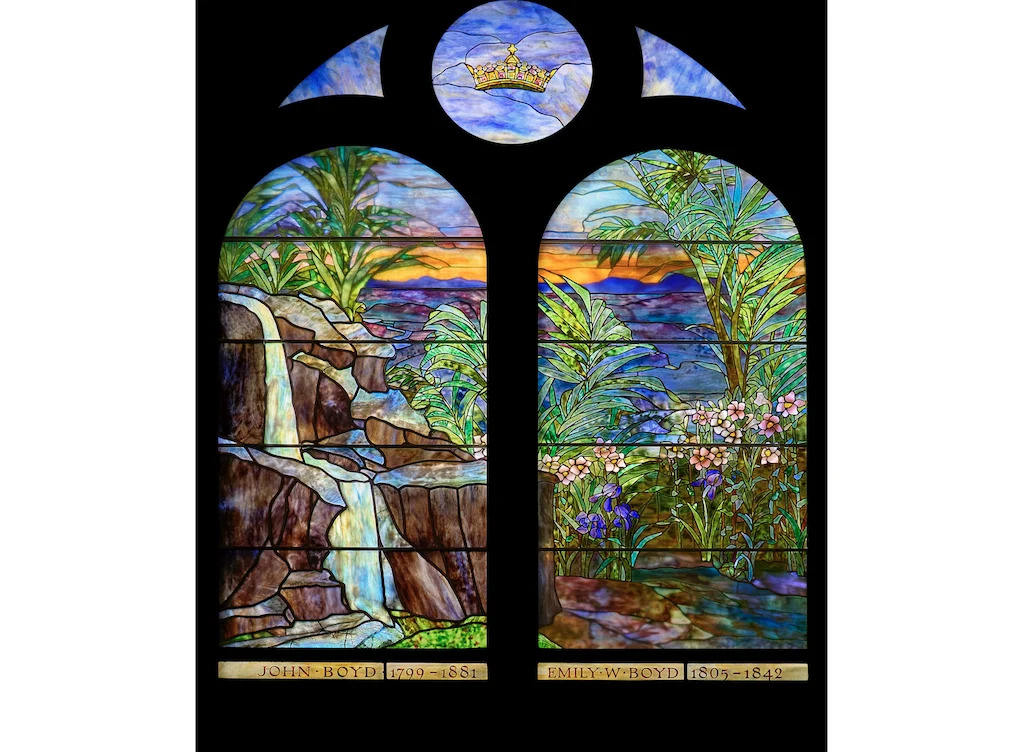
The art market is preparing for a significant event this June as Christie’s New York prepares to auction a monumental piece of American decorative history: a late 19th-century stained-glass window crafted by the legendary Tiffany Studios. Titled The Boyd Family Memorial Window (The Falls), the work has graced the sanctuary of the Second Congregational Church in Winsted, Connecticut, for more than 125 years. With a pre-sale estimate reaching as high as $2 million, the upcoming auction highlights both the enduring legacy of Louis Comfort Tiffany’s vision and a growing trend of religious institutions deaccessioning high-value assets to secure their long-term financial futures.
Artistic Composition and Technical Mastery
The Boyd Family Memorial Window, completed in 1898 and installed the following year, is a two-panel composition that serves as a testament to the technical innovations pioneered by Tiffany Studios during the height of the Gilded Age. Unlike many ecclesiastical windows of the era that focused on biblical figures or hagiography, this work depicts a lush, naturalistic landscape. The scene captures a serene sunset over a mountainous horizon, with a dramatic cascading waterfall serving as the focal point in the foreground.
Art historians have noted that while Tiffany Studios produced thousands of windows, landscape scenes featuring prominent waterfalls are relatively rare within the firm’s catalog. The window is further distinguished by its intricate use of "Favrile" glass—a type of iridescent, opalescent glass patented by Louis Comfort Tiffany in 1894. This material allowed the studio to create painterly effects without the heavy use of enamel paints, relying instead on the internal texture and color of the glass itself to simulate the movement of water, the softness of clouds, and the delicate petals of the flowering lilies and irises that frame the lower portion of the composition.
Adding to its theatricality is a "jeweled" medallion situated at the top of the panels. These "jewels" are thick, multifaceted pieces of glass that catch and refract light in a manner similar to gemstones, a hallmark of Tiffany’s more prestigious and expensive commissions. The combination of these elements creates a three-dimensional depth that was revolutionary at the turn of the 20th century and remains a pinnacle of American glass craftsmanship today.
Historical Provenance and the Winsted Legacy
The window was originally commissioned by Ellen Wright Boyd, a prominent local figure, in memory of her parents. Since its installation in 1899, it has remained a fixture of the Second Congregational Church, filtering light into the sanctuary and serving as a backdrop for generations of congregational life. Winsted, a town known for its industrial history in the late 19th century, was once a hub of wealth and manufacturing, which allowed local families to commission works from top-tier New York firms like Tiffany Studios.
The Boyd window is not the only Tiffany work associated with the church. The institution still holds a figurative window and a mosaic installed in honor of a longtime deacon. However, The Falls has long been considered the crown jewel of the collection due to its scale and the rarity of its subject matter.
In the 1990s, the church undertook a significant conservation project to ensure the window’s longevity. Over a century of exposure to the elements and the weight of the lead cames (the H-shaped strips of lead that hold the glass pieces together) had led to structural sagging and surface grime. Professional restoration addressed these deteriorating elements, stabilizing the glass and cleaning the surface to reveal the original vibrance of the sunset hues. This history of meticulous care is expected to bolster its value at auction, as collectors prioritize works with clear provenance and documented conservation history.
A Growing Trend in the Art Market: From Sanctuaries to Galleries
The decision by the Second Congregational Church to sell The Boyd Family Memorial Window is reflective of a broader pattern affecting historic religious institutions across the United States. As congregations shrink and the costs of maintaining century-old stone structures rise, many churches find themselves "asset-rich but cash-poor." According to Christie’s, the proceeds from the June sale will be used to support the church’s operations and ongoing community programming.
This shift has led to a significant influx of museum-quality Tiffany windows entering the private market. For decades, these works were considered "site-specific" and rarely moved. However, the 21st century has seen a dramatic reassessment of Tiffany windows as standalone masterpieces of fine art rather than merely decorative architectural elements.
Recent years have seen several record-breaking transactions that underscore this trend:
- 2023: The Metropolitan Museum of Art in New York acquired the Garden Landscape (1912), a massive three-part window, signaling the high institutional demand for Tiffany’s landscape works.
- 2024: The Danner Memorial Window (1913) shattered records when it sold for $12.4 million at Sotheby’s. This sale proved that there is a robust appetite for high-tier Tiffany glass among ultra-high-net-worth private collectors.
- 2025: Christie’s successfully placed the Goddard Memorial Window (1910) at $4.2 million, further solidifying the multi-million-dollar floor for rare, large-scale commissions.
- Recent Museum Acquisitions: Crystal Bridges Museum of American Art in Bentonville, Arkansas, recently announced the acquisition of the Mountain Landscape (Root Memorial Window), which was also sourced from a church, specifically one in Texas.
A Chronology of the Boyd Memorial Window
The journey of the Boyd window spans three centuries, reflecting the changing tastes and economic realities of American society.
- 1898: Ellen Wright Boyd commissions Tiffany Studios to create a memorial for her parents. The design is finalized, and the studio begins the labor-intensive process of selecting and cutting Favrile glass.
- 1899: The window is shipped to Winsted, Connecticut, and installed in the Second Congregational Church.
- Early 20th Century: The window survives the Great Depression and the decline of the local manufacturing economy, remaining a symbol of the town’s Gilded Age prosperity.
- 1990s: Recognizing the physical toll of a century of use, the church commissions a full restoration to address structural bowing and lead deterioration.
- 2024: Church leadership, facing modern financial pressures, enters into an agreement with Christie’s New York to auction the piece.
- June 2024: The window is scheduled to headline the Design Sale at Christie’s, where it is expected to fetch between $1.5 million and $2 million.
Inferred Perspectives and Institutional Rationale
While the church has not issued a detailed public statement regarding the emotional weight of the sale, the move is logically inferred to be a strategic decision for the survival of the ministry. For many historic churches, the choice is between preserving a single work of art or preserving the institution’s ability to serve its community. The $2 million expected from the sale could create an endowment capable of funding decades of maintenance, staff salaries, and social services.
From the perspective of the art world, the sale is seen as an opportunity for "re-contextualization." While the window was designed for a specific light source in a specific building, its move to an auction house—and likely a museum or high-profile private collection—allows it to be appreciated by a wider audience as a pinnacle of American Art Nouveau.
Implications for Heritage Preservation
The migration of Tiffany windows from their original architectural settings raises complex questions about heritage preservation. Critics of the trend argue that removing such works strips them of their intended spiritual and community context. When a window leaves a church, the building loses a piece of its soul, and the town loses a tangible link to its history.
However, proponents argue that auctions are often the only way to ensure the long-term survival of the glass itself. If a church were to close or fall into disrepair due to lack of funds, the windows would be at risk of theft, vandalism, or environmental damage. By moving into a controlled museum environment or a prestigious private collection, the Boyd window is guaranteed a level of climate control and security that a struggling parish may no longer be able to provide.
Market Analysis: Why Now?
The timing of the sale is strategically aligned with a peak in the market for American decorative arts. Collectors are currently prioritizing "landscape" windows over "figurative" ones. While religious figures (saints, apostles, etc.) were once the most sought-after, modern collectors often prefer the secular beauty of Tiffany’s nature scenes, which fit more easily into contemporary home designs and non-religious museum wings.
The "waterfall" motif of the Boyd window is a specific "value-add." In the hierarchy of Tiffany designs, water features—particularly those utilizing "ripple glass"—are among the most difficult to execute and the most visually striking. The presence of the jeweled medallion and the 125-year-old provenance makes this an "A-grade" investment for collectors looking for blue-chip American assets.
As the June auction approaches, all eyes will be on Christie’s New York. The sale of The Boyd Family Memorial Window (The Falls) is more than just a transaction; it is a transition point for a piece of American history, moving from the quiet, filtered light of a Connecticut sanctuary to the high-stakes, global stage of the international art market. Whether it ends up in a public institution like the Met or a private estate, its legacy as a masterpiece of Tiffany Studios is firmly secured.