Weather Agency Backs Trump Dorian Could Have Impacted Alabama
Weather agency now backs trump says dorian could have impacted alabama – Weather Agency Backs Trump: Dorian Could Have Impacted Alabama, a statement that sparked a whirlwind of controversy, ignited a firestorm of debate, and thrust the accuracy of weather forecasting into the national spotlight. The genesis of this contentious claim lies in the aftermath of Hurricane Dorian, a powerful storm that ravaged the Bahamas and threatened the southeastern coast of the United States in 2019.
Amidst the chaos and uncertainty, President Trump made a bold declaration, asserting that Alabama was in the path of the hurricane. This assertion, however, contradicted the official forecast issued by the National Weather Service (NWS), leading to a public showdown between the President and the nation’s premier weather agency.
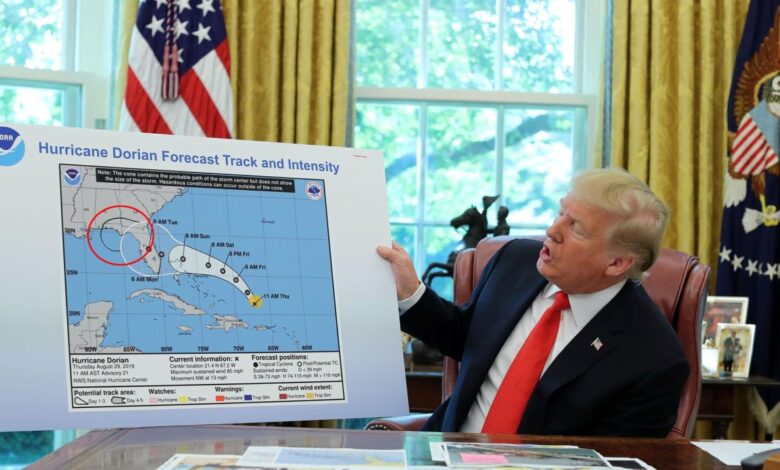
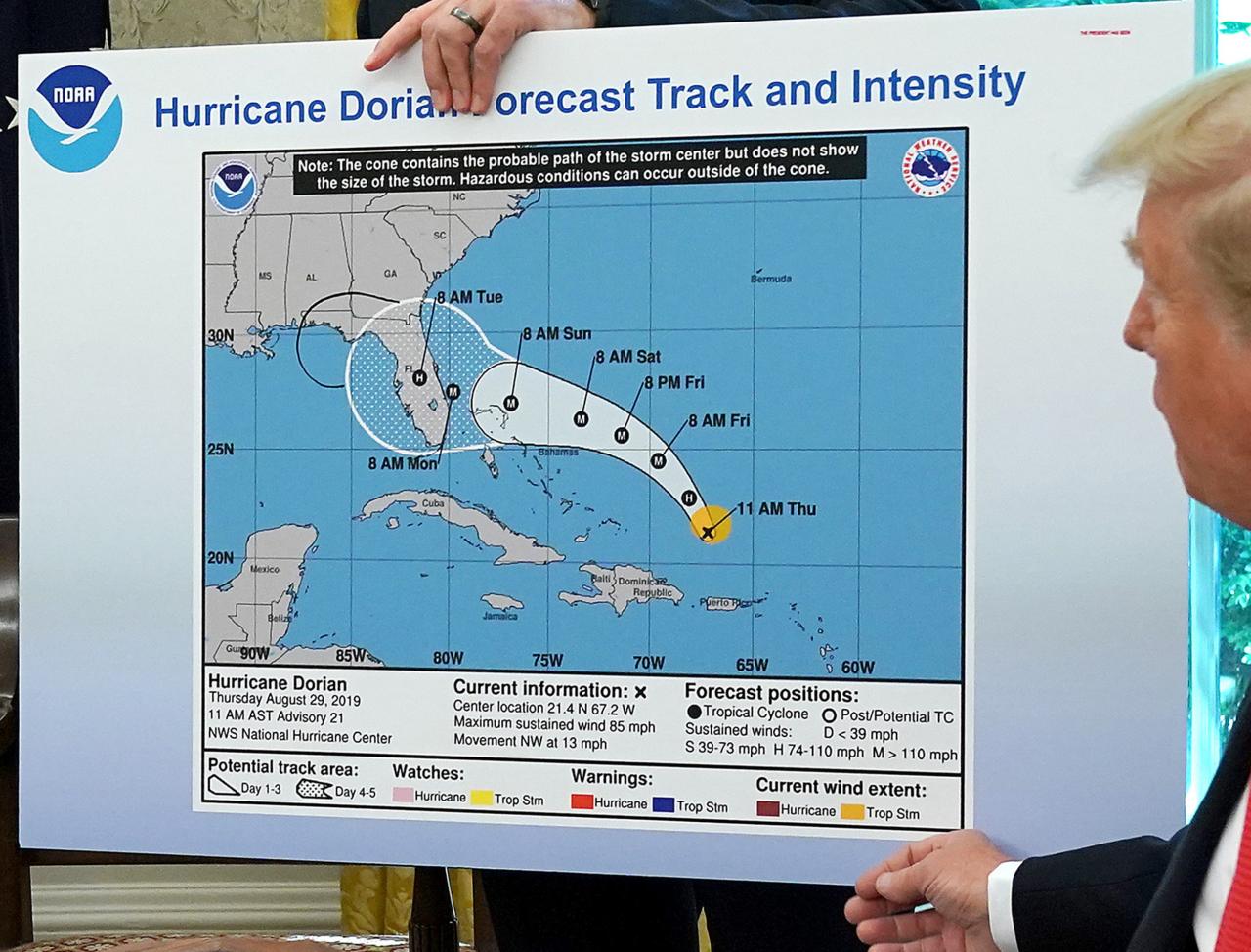
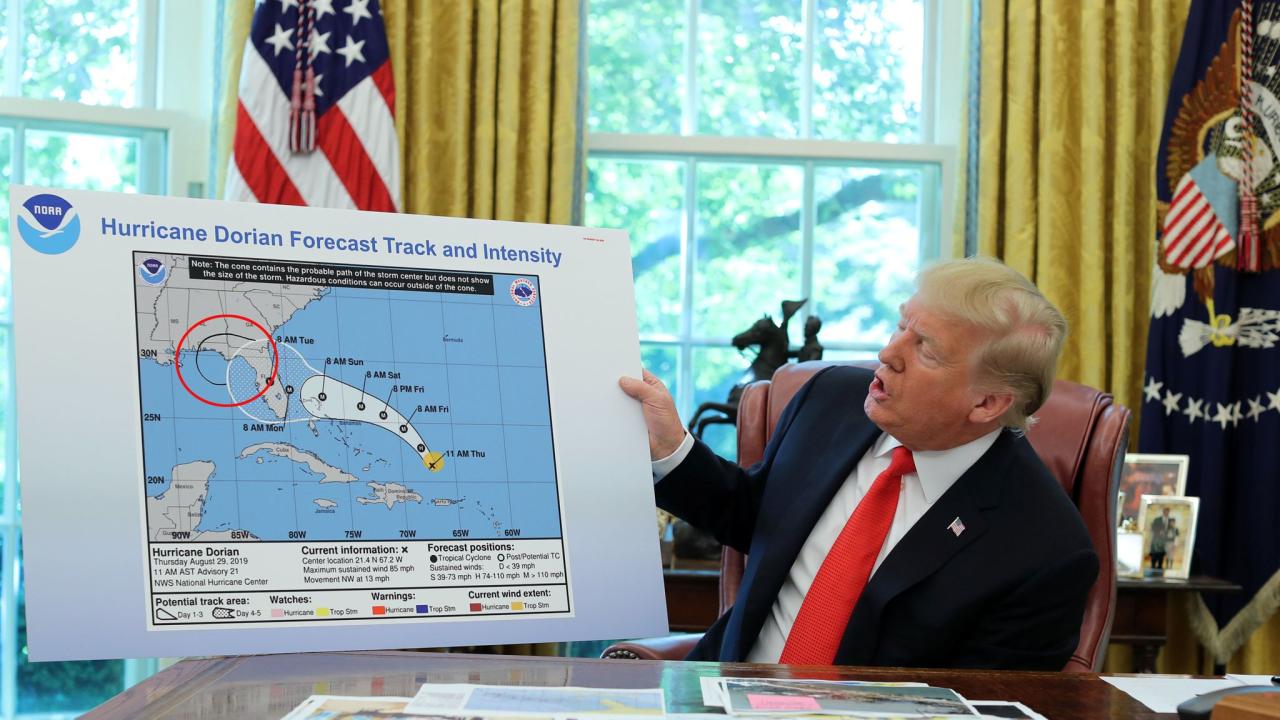
The NWS, a respected and trusted institution, had initially forecasted that Dorian would not directly impact Alabama. However, as the storm’s trajectory shifted, the NWS issued a series of corrections, ultimately confirming that Alabama was not in the direct path of the hurricane. Despite these corrections, President Trump continued to insist that Alabama was indeed in the hurricane’s path, sharing a map that appeared to support his claim.
This discrepancy, amplified by social media, fueled the controversy, raising questions about the reliability of weather forecasting and the role of government in disseminating information during a crisis.
The Controversy
The statement “Dorian could have impacted Alabama” sparked a significant controversy in August 2019, primarily due to its inconsistency with the National Weather Service’s (NWS) official forecast and its subsequent retraction. This incident highlighted the potential for misinformation to spread rapidly in the digital age, particularly through social media platforms.The controversy originated when President Donald Trump, on August 27, 2019, asserted that Hurricane Dorian, then approaching the East Coast of the United States, “could also impact the state of Alabama.” This statement contradicted the NWS’s official forecast, which explicitly stated that Alabama was not in the projected path of the hurricane.
The National Weather Service’s Forecast and Corrections
The NWS’s initial forecast for Hurricane Dorian, issued on August 24, 2019, clearly indicated that the storm was expected to make landfall in the Carolinas and then move north along the East Coast, posing no threat to Alabama. The forecast was based on established meteorological models and data, which consistently predicted the storm’s trajectory.Following the President’s statement, the NWS’s Birmingham office issued a correction, stating that Alabama was not in the hurricane’s projected path.
This correction was made through a tweet, which was later deleted but widely circulated on social media.
Social Media’s Role in Amplifying the Controversy
Social media platforms played a crucial role in amplifying the controversy surrounding the President’s statement. The initial tweet from the NWS’s Birmingham office, correcting the President’s claim, went viral, drawing widespread attention and sparking debate. The incident also highlighted the potential for social media to spread misinformation, particularly when influential figures make unsubstantiated claims.
Trump’s Statements and Actions
The controversy surrounding Hurricane Dorian and its potential impact on Alabama arose from a series of statements and actions by President Donald Trump, which contradicted official forecasts and sparked widespread criticism. These actions also highlighted the role of social media in disseminating information during a natural disaster.
The controversy surrounding the weather agency’s backing of Trump’s claim about Hurricane Dorian potentially impacting Alabama has certainly been a hot topic. While this debate rages on, across the Atlantic, Ireland has taken a decisive stand against perceived foreign interference by ordering the closure of a Chinese police service station in Dublin. This move, reported by Molnewsnet , highlights the growing concerns about the reach of foreign entities within national borders.
It’s fascinating how events on opposite sides of the world can intersect and raise important questions about national security and sovereignty.
Public Statements Regarding Hurricane Dorian
Trump’s statements about Hurricane Dorian’s potential impact on Alabama began on August 27, 2019, during a briefing at the Federal Emergency Management Agency (FEMA). At this briefing, Trump stated that Alabama was “in the direct path” of the storm, even though the National Hurricane Center (NHC) had not issued any warnings for Alabama.
“We have a lot of people in Alabama that are going to get hit very hard.”
President Donald Trump, August 27, 2019
Trump continued to make similar statements on social media, even after the NHC corrected its forecast. He also shared a map that had been altered to include Alabama in the storm’s projected path, which was widely criticized for its inaccuracy.
Social Media Use During the Hurricane
Trump’s use of social media during Hurricane Dorian was controversial. While social media can be a valuable tool for disseminating information during emergencies, Trump’s tweets about the storm were often inaccurate and misleading. This raised concerns about the potential for misinformation to spread during a time when accurate information was critical.
“In addition to Florida, South Carolina, North Carolina, Georgia, and Alabama, which will also most likely be hit (much less than originally predicted)…”
President Donald Trump, September 1, 2019
Trump’s tweets about the storm also often focused on his own accomplishments and the response of his administration, rather than providing information about the storm’s potential impact. This further fueled criticism of his use of social media during the hurricane.
The weather agency now backing Trump’s claim that Dorian could have impacted Alabama has sparked a debate about the reliability of weather forecasts. This incident, however, pales in comparison to the potential consequences of the energy transition, as outlined in a recent energy transition a dangerous delusion report. The report warns that a hasty transition could lead to energy shortages and economic instability, potentially overshadowing any immediate concerns about a hurricane’s path.
Actions Taken by the Trump Administration
The Trump administration took a number of actions in response to Hurricane Dorian, including declaring a state of emergency for Florida and other states in the storm’s path. The administration also deployed FEMA personnel and resources to the affected areas. However, some critics argued that the administration’s response was inadequate, citing the slow pace of aid distribution and the lack of a clear plan for addressing the storm’s aftermath.
The weather agency finally admitting that Hurricane Dorian could have impacted Alabama after Trump’s claims is just another example of how political agendas can cloud scientific judgment. It’s a stark reminder that even experts can be swayed by pressure, which brings to mind Elon Musk’s recent allegations that FTX CEO Sam Bankman-Fried donated over a billion dollars to Democrats. boom elon musk alleges ftx ceo sam bankman fried donated over 1 billion to democrats Whether or not the claims are true, they highlight the complex relationship between money, politics, and public perception, and how even the most trusted sources can be questioned.
Perhaps the Dorian controversy should serve as a cautionary tale about how easily facts can be twisted for political gain.
The Impact of the Controversy
The controversy surrounding President Trump’s statement about Hurricane Dorian potentially impacting Alabama sparked widespread public reaction, fueled political debate, and raised questions about the public’s trust in government institutions and weather forecasting.
Public Reaction
The controversy elicited a diverse range of responses from the public, with many expressing outrage and disbelief at the President’s claims.
- Numerous social media users, meteorologists, and news outlets pointed out the inaccuracy of the President’s statement, highlighting the importance of relying on credible sources for weather information.
- Others expressed concern about the potential for the President’s actions to erode public trust in official weather forecasts, particularly in the face of a natural disaster.
- Some defended the President, arguing that his statement was not intended to be a definitive weather prediction but rather a reflection of the uncertainty surrounding the storm’s path.
Political Implications
The controversy had significant political implications, further polarizing an already divided nation.
- Democrats and other critics of the President condemned his actions as a blatant disregard for facts and an attempt to mislead the public.
- Republicans, on the other hand, were more divided in their responses, with some supporting the President’s claims while others expressed concerns about the potential for the controversy to damage his reputation.
- The controversy also highlighted the growing distrust in government institutions, particularly among those who view the President’s actions as a symptom of a broader pattern of misinformation and disregard for truth.
Impact on Trust in Government Institutions and Weather Forecasting, Weather agency now backs trump says dorian could have impacted alabama
The controversy raised concerns about the public’s trust in government institutions and weather forecasting.
- The President’s actions, which contradicted the official forecasts of the National Weather Service, led some to question the credibility of government agencies responsible for providing accurate weather information.
- This distrust could have serious consequences, particularly in situations where timely and accurate weather information is crucial for public safety, such as during natural disasters.
- The controversy also highlighted the importance of critical thinking and media literacy, emphasizing the need for individuals to rely on credible sources of information, especially in times of crisis.
The Role of the Media
The media played a crucial role in amplifying and shaping public perception of the controversy surrounding Trump’s statements about Hurricane Dorian and Alabama. The reporting of the National Weather Service’s forecast and Trump’s subsequent claims, along with the social media discourse, influenced how the public understood the event and its implications.
Media Coverage of the Controversy
The media coverage of the controversy was extensive and varied, with different outlets adopting different approaches to reporting the story. Some outlets focused on the accuracy of the National Weather Service’s forecast, while others highlighted the discrepancies between the forecast and Trump’s statements. The media also played a significant role in disseminating Trump’s claims and the subsequent backlash they received.
“The media’s coverage of the controversy was extensive and varied, with different outlets adopting different approaches to reporting the story.”
The Impact of Media Coverage on Public Opinion
The media coverage of the controversy had a significant impact on public opinion, influencing how people perceived Trump’s actions and the accuracy of the National Weather Service’s forecast. Some people were more likely to believe Trump’s claims, while others were more likely to trust the National Weather Service. The media coverage also contributed to a polarized public discourse, with different groups of people interpreting the events in different ways.
The Role of Social Media in Shaping the Narrative
Social media played a crucial role in shaping the narrative surrounding the controversy, amplifying the debate and contributing to the spread of misinformation. Social media users shared their own interpretations of the events, often based on their existing political beliefs. This led to the formation of online echo chambers, where people were only exposed to information that confirmed their existing views.
“Social media played a crucial role in shaping the narrative surrounding the controversy, amplifying the debate and contributing to the spread of misinformation.”
The Accuracy of Weather Forecasting: Weather Agency Now Backs Trump Says Dorian Could Have Impacted Alabama
Weather forecasting is a complex process that involves gathering data from various sources, analyzing it using sophisticated models, and interpreting the results to predict future weather conditions. While significant advancements have been made in weather forecasting technology, it remains a challenging task due to the inherent complexities and uncertainties of the atmosphere.
Limitations and Uncertainties in Weather Forecasting
Weather forecasting is not an exact science. The atmosphere is a chaotic system, and small changes in initial conditions can lead to significant differences in future weather patterns. This phenomenon is known as the “butterfly effect,” where the flapping of a butterfly’s wings in one part of the world can theoretically cause a hurricane in another.
- Data Collection and Accuracy: Weather forecasting relies on data from various sources, including weather stations, satellites, and radar systems. The accuracy of these data sources can vary, and there are always limitations in terms of spatial and temporal resolution. For example, weather stations may be sparsely distributed in certain areas, leading to gaps in data coverage.
- Model Complexity and Limitations: Weather models are complex mathematical representations of the atmosphere that attempt to simulate its behavior. These models are constantly being improved, but they still have limitations in their ability to capture all the intricate processes that occur in the atmosphere. This can lead to inaccuracies in forecasts, especially for extreme weather events.
- Unpredictable Events: Certain weather events, such as tornadoes and severe thunderstorms, are inherently difficult to predict due to their rapid development and localized nature. These events often occur on a smaller scale than the resolution of weather models, making it challenging to accurately forecast their occurrence and intensity.
The Role of Human Judgment and Interpretation
Despite the advancements in weather forecasting technology, human judgment and interpretation still play a crucial role in the process. Meteorologists use their expertise and experience to analyze model output, assess the uncertainties involved, and communicate the forecasts to the public in a clear and understandable manner.
- Model Output Interpretation: Weather models generate a vast amount of data, and it is up to meteorologists to interpret this data and make sense of it. They consider the limitations of the models, the specific weather patterns being observed, and the potential for unexpected events.
- Communicating Uncertainty: Weather forecasts are not always perfect, and it is important for meteorologists to communicate the uncertainties involved. They may use terms like “likely,” “possible,” or “unlikely” to convey the level of confidence in a forecast.
- Local Knowledge and Experience: Meteorologists also rely on their local knowledge and experience to refine forecasts. They may consider factors such as terrain, microclimates, and historical weather patterns to provide more accurate and localized predictions.
The Difference Between a Forecast and a Prediction
It is important to distinguish between a weather forecast and a weather prediction. A forecast is a scientific estimate of future weather conditions based on objective data and models. It is a probabilistic statement that expresses the likelihood of certain weather events occurring. A prediction, on the other hand, is a subjective statement about future weather conditions that may not be based on scientific evidence.In the case of Hurricane Dorian, the National Hurricane Center issued a forecast that indicated the storm would not directly impact Alabama.
However, President Trump made a prediction that the storm could impact the state, which was not supported by the available scientific data. This discrepancy led to the controversy surrounding the president’s statements.
The “Dorian Could Have Impacted Alabama” controversy transcended a simple weather dispute, becoming a potent symbol of the deep political divisions that permeated American society. It exposed the fragility of trust in government institutions, the power of social media to shape narratives, and the enduring challenges of navigating a complex and ever-changing world. As the storm clouds of controversy cleared, the enduring question remained: How do we reconcile conflicting information, ensure the accuracy of weather forecasting, and maintain public trust in the face of uncertainty?