Trump Announces Increased Tariffs on China in Latest Trade War Salvo
Trump Announces Increased Tariffs on China in Latest Trade War Salvo: The US-China trade war, a long-running saga marked by escalating tensions, took another dramatic turn as President Trump announced a new round of increased tariffs on Chinese goods. This move, a clear escalation in the ongoing trade dispute, sent shockwaves through global markets and ignited a fierce debate about the potential economic and geopolitical implications.
The announcement, made amidst a backdrop of ongoing trade negotiations, came as a surprise to many. While the Trump administration has long cited unfair trade practices and intellectual property theft as key grievances against China, the latest round of tariffs has raised concerns about the potential for a full-blown trade war, with far-reaching consequences for both economies and the global trade order.
Background of the Trade War: Trump Announces Increased Tariffs On China In Latest Trade War Salvo
The US-China trade war, a protracted economic conflict marked by escalating tariffs and retaliatory measures, has its roots in a long-standing and complex relationship between the two economic giants. While the two nations have engaged in trade for centuries, the current tensions are largely a product of the 21st century’s globalized economy and the shifting dynamics of power.The trade war’s genesis can be traced back to the early 2000s, a period marked by China’s rapid economic growth and its increasing dominance in global manufacturing.
The US, facing growing trade deficits with China and concerns over intellectual property theft, began to express concerns about the fairness of the trading relationship.
Trade Disputes and Tensions, Trump announces increased tariffs on china in latest trade war salvo
The US-China trade relationship has been characterized by a number of trade disputes and tensions over the years, leading to a series of investigations and accusations of unfair trade practices. These disputes include:
- Intellectual Property Theft: The US has long accused China of stealing intellectual property from American companies, including technology, patents, and trade secrets. China’s lax enforcement of intellectual property rights has been a major point of contention.
- Currency Manipulation: The US has accused China of manipulating its currency, the yuan, to gain an unfair trade advantage. By keeping the yuan artificially low, Chinese exports become cheaper, while US imports become more expensive.
- Market Access: The US has also raised concerns about China’s limited market access for American businesses. China’s restrictive regulations and barriers to entry have made it difficult for US companies to compete in the Chinese market.
- Trade Deficits: The US has consistently run large trade deficits with China, which has fueled concerns about the sustainability of the trade relationship. These deficits have been attributed to China’s unfair trade practices and the US’s growing consumption of Chinese goods.
Timeline of Key Events
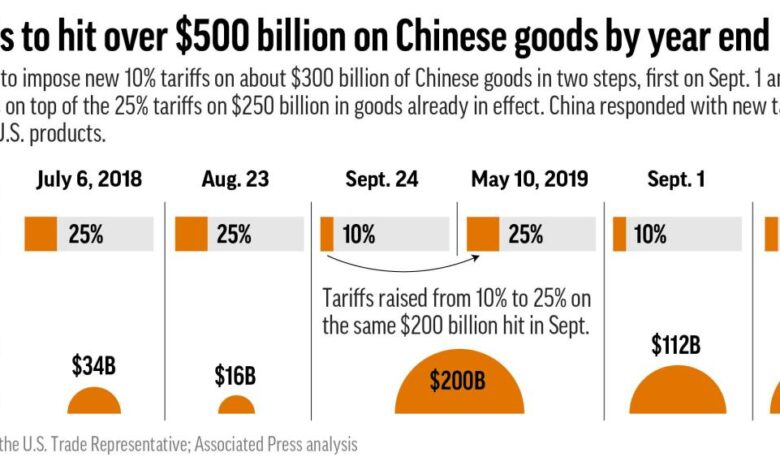
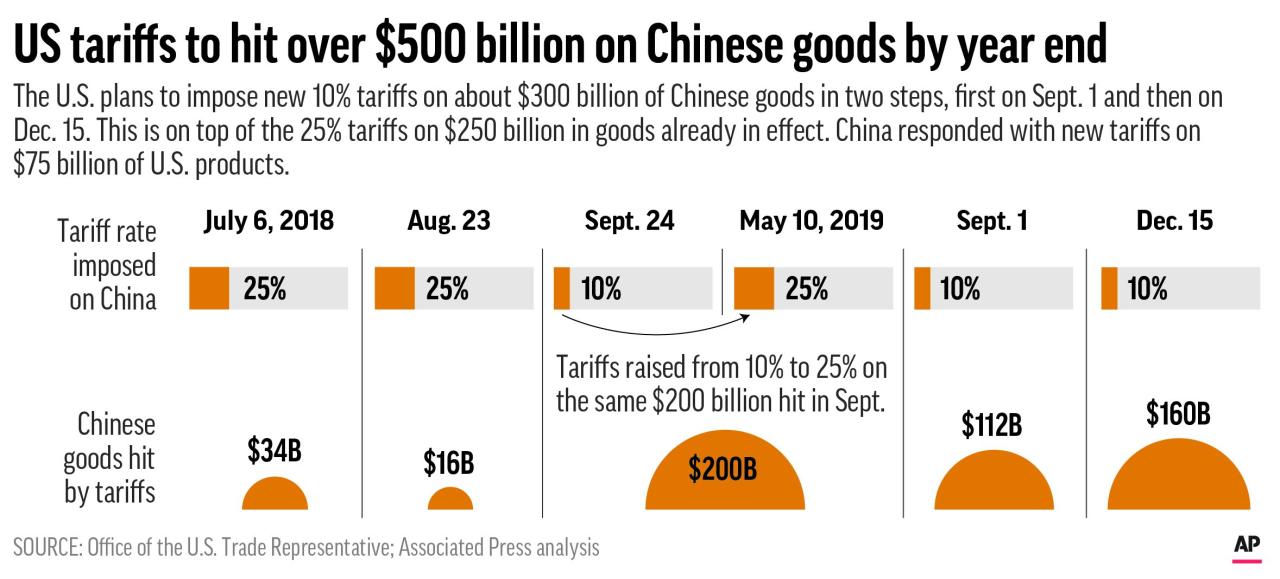
The trade war has unfolded in a series of escalating rounds, marked by the imposition of tariffs on various goods and retaliatory measures. A timeline of key events includes:
- January 2018: The Trump administration imposes tariffs on solar panels and washing machines, citing unfair trade practices by China.
- March 2018: The US launches an investigation into China’s intellectual property practices under Section 301 of the Trade Act of 1974.
- April 2018: The US imposes tariffs on $50 billion worth of Chinese goods, targeting technology and industrial products.
- July 2018: China retaliates with tariffs on $34 billion worth of US goods, targeting agricultural products and vehicles.
- August 2018: The US imposes tariffs on an additional $16 billion worth of Chinese goods.
- September 2018: China retaliates with tariffs on an additional $16 billion worth of US goods.
- September 2018: The US announces plans to impose tariffs on $200 billion worth of Chinese goods.
- October 2018: The US and China hold trade talks in Washington, D.C., but fail to reach an agreement.
- December 2018: The US imposes tariffs on $200 billion worth of Chinese goods, and China retaliates with tariffs on $60 billion worth of US goods.
- May 2019: The US and China hold trade talks in Beijing, but fail to reach an agreement.
- May 2019: The US increases tariffs on $200 billion worth of Chinese goods from 10% to 25%.
- June 2019: China retaliates with tariffs on $60 billion worth of US goods.
- December 2019: The US and China sign a “Phase One” trade deal, agreeing to reduce some tariffs and increase Chinese purchases of US goods.
- January 2020: The “Phase One” trade deal goes into effect.
- May 2020: The US and China agree to delay the implementation of new tariffs.
- July 2020: The US and China hold trade talks in Washington, D.C., but fail to reach an agreement.
- September 2020: The US and China agree to hold further trade talks.
The future of the US-China trade war remains uncertain. While some experts believe that the increased tariffs could be a negotiating tactic aimed at pressuring China into concessions, others fear that the escalation could lead to a protracted trade war with devastating consequences for both countries. The outcome of this trade dispute will have significant implications for global trade, the international economic order, and the relationship between the world’s two largest economies.
Trump’s announcement of increased tariffs on China in the latest trade war salvo is a move that will likely have ripple effects throughout the global economy. One immediate impact is likely to be felt at the pump, as the cost of transporting goods increases. Diesel prices keep climbing making inflation harder to root out , adding further strain to an already challenging economic climate.
While the move may be intended to pressure China into making concessions, it could ultimately backfire, leading to higher prices for consumers and businesses alike.
Trump’s latest salvo in the trade war with China, announcing increased tariffs, has once again put the economy on edge. Meanwhile, the political landscape is heating up as well, with retired general advances to battle new hampshire incumbent hassan for us senate seat in a race that could have major implications for the future of the country. It’s clear that these are turbulent times, both economically and politically, and the outcome of these battles will have a significant impact on our lives for years to come.
Trump’s latest trade war salvo, increasing tariffs on China, has dominated headlines, but amidst the economic turmoil, a different kind of battle is playing out in the courts. In a surprising development, a judge has ordered the release of the leaders of “True the Vote,” a group accused of voter fraud, from jail. court orders release of true the vote leaders from jail While the trade war continues to simmer, the legal battle over election integrity is sure to have its own set of ramifications.